
An inverter air conditioner has a variable-speed compressor that adjusts its output to the heat in your home. A non-inverter unit has a fixed-speed compressor that runs at full power or not at all. Inverter systems usually cost more up front and use less energy when they run for long hours. Fixed-speed systems cost less to buy and are simpler to repair. In a hot, humid place like Richmond, TX, where the AC works most of the year, the inverter is often the better fit, but only if it is sized and installed correctly.
In the US, you will see inverter systems sold as “variable-speed” or “variable-capacity.” Non-inverter systems are called “single-stage.” It is the same technology under different names. This guide uses all of them so you can follow the equipment quotes you get.
TL;DR
- An inverter (variable-speed) AC changes compressor speed to match demand. A non-inverter (single-stage) AC is either full blast or off.
- Inverter systems cost more to buy, but they save the most energy in homes where the AC runs long hours, and they run more quietly.
- Inverter systems depend on more electronics, so surge protection, correct sizing and a proper load calculation matter more.
- A fixed-speed system is still a sensible choice for a rarely used room, a rental on a tight budget, or a short-term home.
- Whichever type you pick, installation quality decides whether you get the benefits you paid for.
Table of Contents
- How each type of air conditioner works
- Why part-load operation matters
- Inverter vs. non-inverter AC: side-by-side comparison
- Cost: what you pay up front and what you save
- Efficiency ratings and what ENERGY STAR says
- Comfort: noise, temperature and humidity
- Sizing matters more with an inverter
- Reliability, repairs and surge protection
- When a non-inverter system still makes sense
- When an inverter is worth it
- Perspective: what we tell Richmond homeowners
- How to choose: a short checklist
- Planning a new system? Start with an honest quote
- FAQ
- Sources
How each type of air conditioner works
Non-inverter: a compressor with two settings
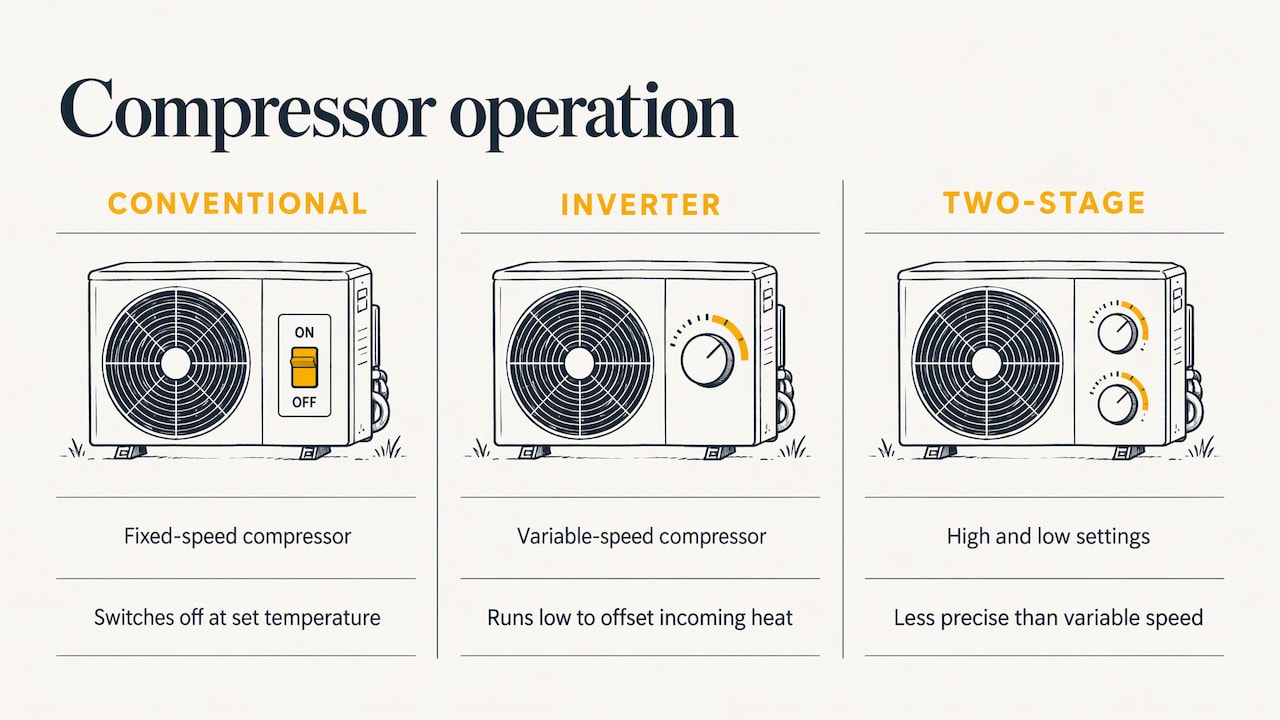
The compressor in a conventional unit runs at one speed. When the thermostat calls for cooling, it starts at full power. When the room reaches the set temperature, it shuts off. Then the temperature drifts up, and it starts again. The result is a cycle of loud starts, full-power runs and stops.
That is simple, proven and cheap to build. It is also why you feel temperature swings and hear the unit kick on.
Inverter: a compressor that adjusts
An inverter drive controls the compressor motor’s speed. Instead of switching off at the set temperature, the unit slows down and keeps running at a low output that just offsets the heat coming in. Consumer Reports describes the advanced compressor as helping the unit run quietly and hold a room at a steady temperature.
Some inverter models can run at a small fraction of full capacity, and a few top-tier systems adjust in very fine steps. Two-stage systems sit between the two types: they have a high and a low setting, which is better than single-stage but not as precise as true variable speed.
Why part-load operation matters
Your AC rarely needs full capacity. Design conditions, the hottest days of the year, happen for a small share of the cooling season. The rest of the time, the house needs less cooling than the unit can deliver. ASHRAE Journal authors note that modern design focuses on part-load efficiency, at points such as 50% and 75% load, because systems seldom run flat out. Conventional systems are optimized for peak load. Inverter technology does well at those in-between points.
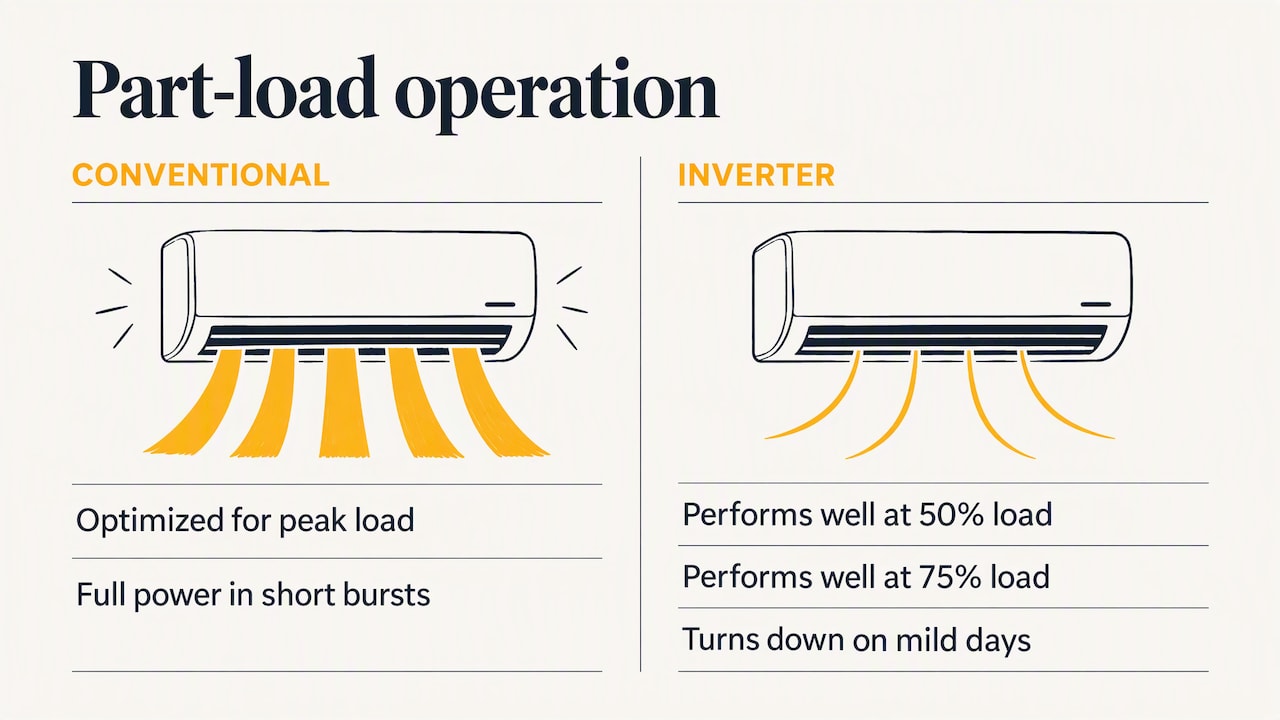
That is the real reason inverters save energy. It is not magic. A fixed-speed unit that is oversized for a mild day keeps running full power in short bursts. A variable-speed unit just turns down.
Inverter vs. non-inverter AC: side-by-side comparison
| Factor | Non-inverter (single-stage) | Inverter (variable-speed) |
|---|---|---|
| Compressor | Fixed speed, on or off | Adjusts speed to demand |
| Upfront cost | Lower | Higher |
| Running cost | Higher when used many hours | Lower when used many hours |
| Temperature control | Swings around the set point | Steadier |
| Noise | Loud starts and stops | Generally quieter, may have a high-pitched tone |
| Humidity control | Adequate if correctly sized | Often better from long, low-speed runs |
| Electronics | Simple relays | More complex drive and controls |
| Sizing sensitivity | Forgiving to a degree | Needs an accurate load calculation |
| Best for | Occasional use, tight budgets | Long run hours, comfort, efficiency |
The table is a general summary. Individual models differ, so compare the rated efficiency (SEER2), warranty and sound ratings on the specific systems in your quotes.
Cost: what you pay up front and what you save
The main drawback of inverter technology is price. The variable-speed compressor and the control electronics cost more to make. Consumer Reports notes that the price gap has narrowed, and some highly rated inverter models are priced similarly to or below conventional alternatives.
On savings, be realistic. The same Consumer Reports piece cites a Department of Energy analysis: moving to a more efficient window air conditioner saves roughly $18 to $21 per year, or about $167 to $189 over a nine-year typical life. That is a small unit with modest use. A whole-home system in a Texas summer runs far more hours, so the potential is larger, but nobody can promise you an exact number without knowing your house, your ducts and your rates.
Here is a simple way to think about it:
- Ask each contractor for the cost of both a single-stage and a variable-speed option on the same size and brand line.
- Subtract to get the price premium.
- Compare the rated efficiency and ask for an estimate of annual cooling use for your home.
- Divide the premium by the estimated annual savings. That is your payback period.
- Add the comfort factors, such as quiet and humidity, which do not show up on the bill.
If the payback is longer than you expect to stay in the house, a single-stage system may be the smarter call. If you plan to stay a decade, the inverter usually wins.
What a replacement costs with us
For reference, our published range for a full AC system replacement is $3,500 to $8,000. Where your project lands depends on the size of the home, the equipment you choose and the condition of the existing ductwork. We give you the number after we look at the house, not before.
Efficiency ratings and what ENERGY STAR says
You do not need an inverter to earn an ENERGY STAR label. According to EPA guidance on the program, staged or variable-capacity operation is no longer required at every certification level, because well-designed fixed-speed equipment can still meet the thresholds. The top Most Efficient tier, however, is dominated by variable-speed designs.
So the label alone does not tell you which technology you are getting. Check the model’s specification sheet for “variable-capacity,” “inverter” or “modulating,” and compare the SEER2 numbers directly.
Comfort: noise, temperature and humidity
Noise
Part of the quiet comes from avoiding the sudden mechanical start of a fixed-speed compressor. Running at a steady lower speed is also gentler on parts. Honest caveat: inverters are not silent. ASHRAE’s handbook chapter on noise and vibration control covers variable-speed motor controls, and drive electronics can produce a high-frequency tone that some people notice more than the low drone of a conventional unit. Good installation and vibration isolation make a real difference.
Temperature
Because the system trims output instead of cycling, rooms stay closer to the set temperature. If you have an upstairs that always runs hot, an inverter will not fix a duct or airflow problem by itself. We cover that in our piece on hot spots in two-story Richmond homes.
Humidity
In the Houston area, humidity is half the job. A system that runs longer at lower speeds removes more moisture than one that blasts and stops. But there is a catch: an oversized system of either type can cool the air before it has pulled out enough moisture, leaving the home feeling clammy. Sizing is the lever.
Sizing matters more with an inverter
Inverter systems are less forgiving of a bad size. According to Consumer Reports, an undersized unit runs flat out and loses its efficiency advantage, while an oversized one can fail to manage humidity. The fix is a proper load calculation, not matching the capacity of the old unit.
ASHRAE says that rules of thumb almost always lead to an oversized system, with higher first cost, higher utility bills, more maintenance and shorter equipment life. That is the reason we do not size by square footage alone. If a contractor quotes you without measuring or asking about insulation, windows, ducts and sun exposure, ask how they arrived at the size.
Reliability, repairs and surge protection
The electronics are the tradeoff. An inverter drive is a circuit board and power electronics. A single-stage unit uses simple relays and a capacitor. ASHRAE Journal authors describe inverter drives as more sensitive to power fluctuations and moisture in outdoor cabinets, which is why professional-grade surge protection for the outdoor unit makes sense. In a region with summer thunderstorms, that is not a throwaway extra.
On the other hand, smooth running means fewer hard starts, which is easier on the compressor over the years. You trade simpler repairs for potentially longer life.
For reference, here are our published ranges for common repairs on either type of system:
| Repair | Published range |
|---|---|
| Diagnostic visit | $75 to $150 |
| Capacitor replacement | $150 to $400 |
| Thermostat replacement | $150 to $400 |
| Condensate drain clearing | $75 to $200 |
| Blower motor replacement | $400 to $900 |
| Compressor replacement | $800 to $2,800 |
| Refrigerant leak repair and recharge | $250 to $1,500 |
Prices are one-off service ranges. The final cost depends on the diagnosis, and you can see the full list on our AC repair page. If your current system is aging and a major repair is on the table, our repair vs. replace guide walks through the math.
When a non-inverter system still makes sense
Inverter is not automatically the right answer. According to the ASHRAE guide to choosing a system, a variable-capacity system’s efficiency advantage grows with run time, while a fixed-speed unit is more cost-effective for minimal or occasional use. Fixed-speed can be the better call when:
- The space is used only part of the year, such as a guest house, a workshop or a seasonal rental.
- You plan to sell within a few years and will not recoup the premium.
- The budget is firm and an emergency replacement cannot wait.
- Your ducts are poor and need work first. Spending on the compressor before fixing airflow wastes money.
A mid-range option is a two-stage system, which gives you some of the comfort gain at a smaller premium.
When an inverter is worth it
An inverter usually pays off when:
- The AC runs most of the day for months, which describes much of the Texas Gulf Coast summer.
- You care about quiet, for bedrooms or a home office.
- Humidity and even temperatures are a complaint.
- You expect to stay in the home for ten years or more.
- You are replacing the whole system, not just one component, so the indoor and outdoor parts can be matched.
A Mint report makes the same point: inverter units save the most in hot climates and with long daily use. Note that it was written for the Indian market, so use it for the principle, not the figures.
Perspective: what we tell Richmond homeowners
We get this question in two situations. One is a calm one: a homeowner planning ahead. The other is at 4 p.m. in July, when the AC has quit and a family needs an answer today.
In both, we say the same thing. The technology matters less than the fit. We have seen a well-sized, well-installed standard system beat a poorly installed premium one. The reverse is also true: a family that runs the AC 10 months a year and pays for the cheapest unit often regrets it by the third summer.
Our approach is simple. We look at the house, run the numbers, and show you options with the price difference spelled out. If a single-stage system is the honest answer, we say so. If variable speed would serve you better, we explain why, and what extra protection, such as surge protection, belongs with it. You decide with the facts in front of you, and nothing is a surprise on the invoice.
One more thing: whatever you install, maintenance is what keeps the efficiency you paid for. Dirty coils and clogged drains cost more than the difference between the two technologies. A yearly tune-up is the cheapest insurance in HVAC.
— Wally
How to choose: a short checklist
- Count your run hours. If the AC runs most of the day for much of the year, lean toward inverter.
- Get a load calculation. Do not accept a size based on the old unit.
- Ask for both options priced. Single-stage and variable-speed, same brand line, same scope.
- Check the ratings. Compare SEER2 and sound levels, not marketing terms.
- Ask about surge protection. Especially for variable-speed equipment.
- Check the ducts. Leaky or undersized ducts undercut any compressor.
- Plan for maintenance. Ask what is covered and how often service is needed.
Our homeowner checklist for finding a reliable contractor gives you more questions to ask any company, including us.
Planning a new system? Start with an honest quote
If you are weighing inverter and standard systems for a Richmond-area home or business, we can measure, calculate and price both so the difference is clear. Our NATE-certified technicians handle AC installation and replacement, and we offer flexible financing options. If your system is already struggling, book a diagnostic visit through our HVAC services page. To protect whichever system you choose, look at our HVAC maintenance plans.
FAQ
Does an inverter AC really save electricity?
Yes, in most cases where it runs for long hours. It slows down instead of cycling at full power, which is efficient at the part-load conditions where systems spend most of their time. The savings depend on your usage, home and rates, so ask for an estimate rather than relying on a general percentage.
What is the disadvantage of an inverter AC?
The higher purchase price is the main one. The drive electronics are also more sensitive to power surges and moisture, so surge protection and correct installation matter. Repairs to a control board can cost more than swapping a simple capacitor or relay.
Are inverter ACs quieter than conventional ones?
Generally, yes, because they avoid the loud full-power starts of a fixed-speed compressor. Some units produce a faint high-pitched tone, so listen to a model if you can. Installation and isolation affect the final sound as much as the compressor type.
Is a non-inverter AC a bad choice?
No. For occasional use, a short time in the home or a tight budget, a well-sized single-stage system works and is easier to service. It just tends to cost more to run when used heavily and gives less even comfort.
Do I need to replace my whole system to get an inverter?
Usually, yes. The indoor and outdoor equipment need to be matched to work properly with variable-speed controls. A technician can check your current equipment and tell you what is compatible before you commit.
Sources
- Inverter Air Conditioner Can Keep You Cool, Save You Money, Consumer Reports
- Choosing the Right System for Your Home, ASHRAE
- Variable Speed Oil-Free, ASHRAE Journal
- Noise and Vibration Control, ASHRAE Handbook, Chapter 49
- ENERGY STAR Most Efficient 2025 and Version 6.2 Heat Pump Final Specification Cover Letter
- Inverter AC vs non-inverter AC: Which one actually saves more electricity?, Mint