
Why Is My Electric Bill So High This Winter? Aux Heat, Heat Strips and Heat Pump Problems in Richmond, TX
Your December bill came in and it's nearly as high as August. Richmond doesn't get many truly cold days, so that shouldn't happen. If your home heats with electricity, the cause is almost always the same: your backup heat strips are doing work your heat pump should be doing. Sometimes that's normal for a few freezing nights. Often it's a sign that something in the system has failed and the strips are quietly covering for it.
This guide shows you how to tell the difference in about five minutes, what's actually costing you money and when it's worth a service call.
Already seeing "AUX" on your thermostat on a mild day? Call (346) 485-8142 and we'll check your heat pump before the next bill.
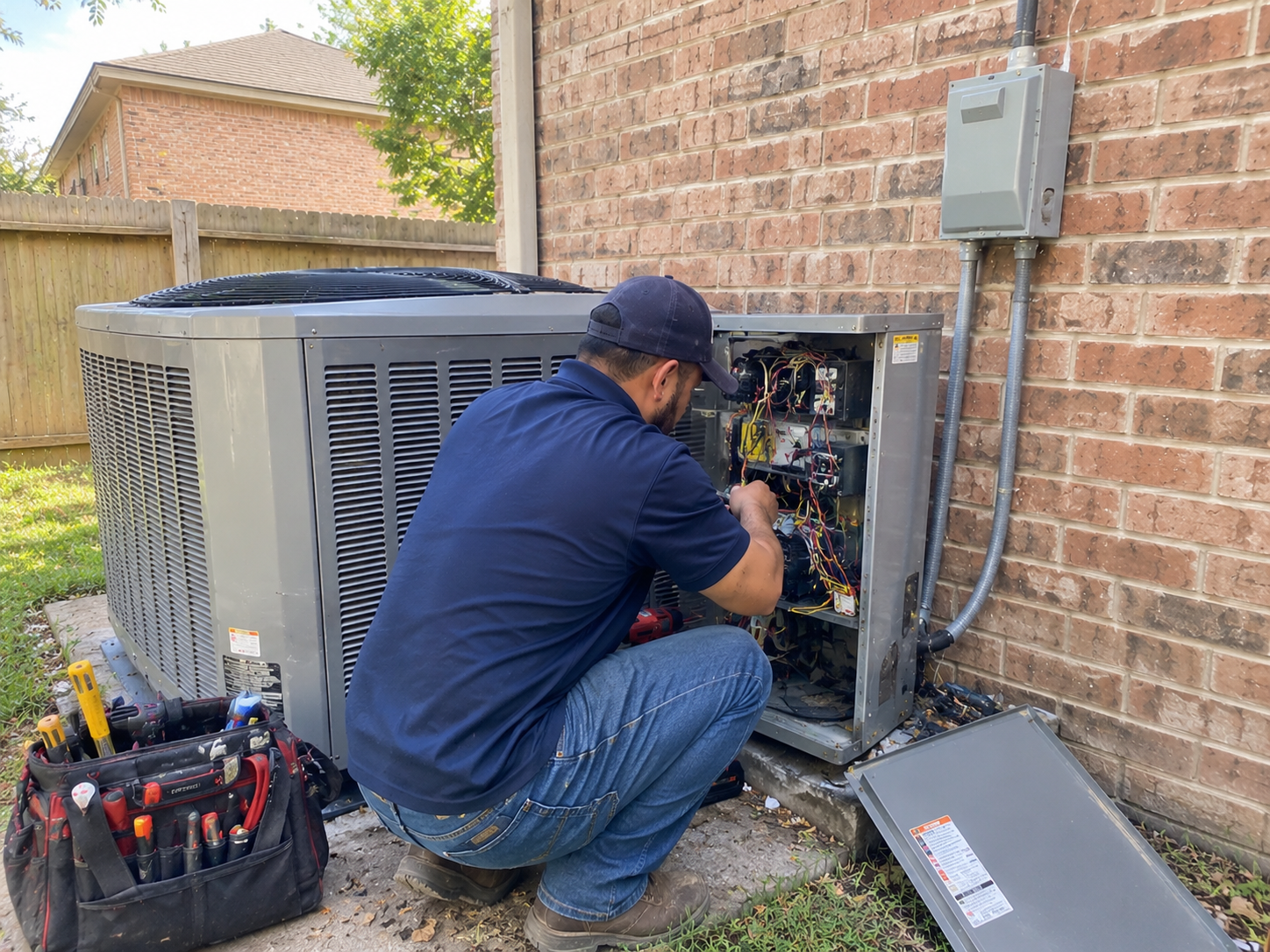
The Short Answer
Most high winter bills in all electric Richmond homes come from electric resistance heat strips running too much. A heat pump moves heat from outside air and uses about a third of the electricity of heat strips for the same warmth. Strips are meant to help only on the coldest mornings or when the heat pump is defrosting. If the heat pump has a problem, the thermostat is set up wrong or emergency heat was left on, the strips run for hours and your bill can double.
ExpectedNormal: AUX shows up briefly on freezing mornings or during a defrost cycle.
Needs a lookNot normal: AUX or EM HEAT stays on when it's above about 40°F outside, the outdoor unit isn't running while the heat is on, or your kWh use jumped with no cold snap to explain it.
Step One: Rule Out Your Electricity Rate
Before you blame the system, look at the kWh used on your bill, not just the dollar amount. In Texas, a fixed rate contract that quietly expired can roll you onto a higher variable rate, and the bill climbs even though you used the same amount of power.
- If your kWh is about the same as last winter and only the price went up, it's your electricity plan, not your HVAC.
- If your kWh jumped, keep reading.
For a closer look, log in to Smart Meter Texas. It shows your home's use in 15 minute intervals. Heat strip problems show up as tall spikes, usually between about 5 and 8 AM, when the house is coldest and the system is catching up.
Step Two: Know What Heats Your Home
Many Fort Bend County homes heat with gas, and gas homes don't get this kind of electric bill spike. Here's how to tell what you have.
| What you see | What you likely have |
|---|---|
| The outdoor unit runs in winter while the heat is on | Heat pump with backup heat strips |
| The thermostat shows "AUX," "EM HEAT" or "Emergency Heat" options | Heat pump |
| A gas meter, and a metal flue pipe running up from the furnace in the attic or closet | Gas furnace. A high bill here is likely about something else. |
| No gas service, and the outdoor unit stays off all winter | Electric furnace (heat strips only). That's the most expensive way to heat, and these homes see the biggest winter bills. |
Not sure which you have? Our post Do Homes in Rosenberg Use Heat Pumps? explains what's common in local homes.
Aux Heat vs Emergency Heat: The Setting That Costs People the Most
Both settings use the same heat strips, but they work very differently.
| Question | AUX heat | EM heat (emergency heat) |
|---|---|---|
| How it turns on | Automatically, when the heat pump needs help | Manually, when you select it |
| Is the heat pump running? | Yes, the strips add heat alongside it | No, the heat pump is shut off and the strips do everything |
| When it should be used | Freezing mornings, defrost cycles, large temperature jumps | Only when the heat pump is broken and you're waiting on a repair |
| Cost | Higher than the heat pump alone, but brief | The most expensive way to heat your home |
One of the most common causes of a shocking bill is simple. Someone switched to emergency heat during a cold snap because it sounded like the right choice for a "heat emergency," then forgot to switch it back. Check your thermostat now. If it says EM HEAT and your heat pump works, switch it back to regular Heat.
What Heat Strips Actually Cost to Run
Residential heat strips usually draw between 5 and 15 kilowatts. Here's what that means at an example rate of 15 cents per kWh:
| Heat strip size | Cost per hour | Running 8 hours a day for 30 days |
|---|---|---|
| 5 kW | About $0.75 | About $180 |
| 10 kW | About $1.50 | About $360 |
| 15 kW | About $2.25 | About $540 |
A working heat pump delivers the same heat for roughly one third of that, because it moves heat instead of making it. So in the 10 kW example, the heat pump would cost about $120 instead of $360. That gap is the extra money on your bill when the strips take over.
7 Problems That Make Your Heat Strips Run Too Much
1. The heat pump stopped heating, but the strips hid it
This is the one that catches people off guard. If the outdoor unit fails, the strips can still keep the house warm. The house feels fine, so nobody notices anything until the bill arrives. Then spring comes, the AC won't cool, and the same failure finally shows up.
2. Emergency heat was left on
Covered above, and easy to fix yourself.
3. A stuck heat strip relay
The relay or sequencer that switches the strips on and off can stick closed. Then the strips run every time the blower runs, even in mild weather and sometimes in spring with the AC on. Signs include a burning dust smell, very hot air from the vents and an AC that "can't keep up" later in the year.
4. Low refrigerant
A heat pump low on refrigerant produces weak, lukewarm heat. The thermostat sees the house falling behind and calls the strips in more and more often. Low refrigerant always means a leak somewhere, and topping it off without finding the leak only buys time.
5. Defrost problems
In cold, damp weather, frost forms on the outdoor coil, and the heat pump runs short defrost cycles to clear it. During a defrost cycle it's normal to see steam, hear a whoosh and see AUX come on briefly. It's not normal for the outdoor unit to be covered in a solid block of ice. A failed defrost control or sensor keeps the heat pump from making useful heat, so the strips carry the load.
6. Thermostat settings that call for backup heat too soon
Many smart thermostats are installed with factory defaults that bring on the strips whenever the house falls a degree or two behind, at any outdoor temperature. A large overnight setback has the same effect. If you drop the temperature six degrees at night and the system catches up at 6 AM, the strips do most of that work. Heat pumps do best with small, steady setbacks or with smart recovery turned on. If your thermostat lets you set a maximum outdoor temperature for aux heat, a setting around 35 to 40°F stops the strips from running on mild days. Our smart thermostat installation service includes setting this up correctly for heat pumps.
7. Airflow and duct losses
A clogged filter, closed vents or leaky ducts in a hot or cold attic all reduce the heat that reaches your rooms. The house falls behind, and the strips make up the difference. In older Richmond homes with original attic ductwork, duct leaks alone can waste a large share of the heat you pay for.
The 5 Minute Self Check
Do this on a day when it's above about 40°F outside and the heat is running.
- Look at the thermostat. Is it set to Heat, not EM Heat? Is AUX showing continuously? On a mild day, it shouldn't be.
- Go outside. Is the outdoor unit running? Its fan should be spinning and you should hear the compressor. If the heat is on inside and the outdoor unit is silent, the strips are doing all the work.
- Check for ice. A light frost that clears every so often is normal. A thick sheet of ice covering the coil is not.
- Feel a supply vent. Heat pump air feels warm, not hot. Air that feels very hot on a mild day usually means the strips are on.
- Check the filter. If you can't see light through it, replace it.
If you found EM HEAT on, switch it back and watch your next few days of usage. If the outdoor unit isn't running, it's iced over, or AUX keeps showing on mild days, the system needs a technician. Call (346) 485-8142.
When a Higher Bill Is Normal in Richmond
Most winter nights in Richmond stay above freezing, so a properly sized heat pump should carry nearly all the load on its own. A correctly sized system typically only needs backup heat somewhere around 30°F and below.
Hard freezes are the exception. During the January 2024 cold snap, when temperatures around Houston dropped to 18°F, every heat pump in the area leaned heavily on its strips, and a higher bill that month was expected. The difference is that a healthy system's bill drops back to normal as soon as the weather does. If yours stays high in mild weather, something is wrong.
Cold weather is also hard on plumbing. See how to protect your pipes from freezing before the next hard freeze.
What Our Technician Checks
When you call us about a high winter bill, we don't stop at "it's heating." We test the parts that decide how much of your heat comes from the efficient heat pump and how much from the strips:
- Heat pump operation in heating mode, including the reversing valve
- Refrigerant pressures and temperatures, plus a leak check if the charge is low
- The defrost board, sensor and a full defrost cycle
- Heat strip amp draw, and whether the relays switch off when they should
- Thermostat wiring and aux heat settings
- The air filter, blower and airflow at the vents
- Visible duct leaks at the air handler and in the attic
You get a clear explanation of what we found, photos of the problem and a written quote before any repair. See our heat pump repair service in Richmond, or our heating repair page if you have a gas or electric furnace.
Repair or Upgrade?
If you have an electric furnace with no heat pump, every unit of heat comes from the expensive strips. When your AC is due for replacement, switching to a heat pump is usually the single biggest way to lower winter bills in an all electric home. CenterPoint Energy has run programs that help with heat pump upgrades, so ask about current incentives when you get a quote.
If your heat pump is older and needs a major repair, compare the repair cost to the system's age and condition. Our repair vs replace guide walks through that decision. For the lowest bills, variable speed heat pumps can slow down instead of shutting off, which keeps them heating without the strips for longer. Learn more about the Day & Night Ion system.
A yearly tune up before the first cold front catches many of these problems early. See our HVAC maintenance plans.
Frequently Asked Questions
Why is my electric bill so high in winter if it's not that cold?
In an all electric home, the usual cause is backup heat strips running when they shouldn't. That happens when the heat pump isn't working properly, emergency heat was left on or the thermostat calls for aux heat too easily. Check your kWh first to rule out a rate change.
Is it bad if my thermostat says AUX?
Not if it's brief. Short AUX periods on freezing mornings or during defrost are normal. AUX that stays on for long stretches on days above about 40°F points to a problem with the heat pump or the thermostat settings.
Should I use emergency heat when it's really cold?
No. Emergency heat is for when the heat pump is broken. On a cold day, a working heat pump plus automatic aux heat is far cheaper than emergency heat alone.
How much does running heat strips cost?
Residential strips usually draw 5 to 15 kW. At 15 cents per kWh, that's about $0.75 to $2.25 an hour. Running a 10 kW strip eight hours a day for a month adds roughly $360 to your bill.
Why is my heat pump covered in ice?
Light frost is normal in damp, cold weather, and the defrost cycle should clear it regularly. A thick block of ice that doesn't clear means a defrost failure, low refrigerant or an airflow problem. Turn the system to EM HEAT temporarily to protect the outdoor unit and call for service.
Can a heat pump problem cause a high bill in spring or summer?
Yes. A heat strip relay stuck on can run the strips whenever the blower runs, even with the AC on. That raises your bill and makes the AC seem weak. A burning dust smell and very warm vent air are clues.
What temperature should I set my heat pump to in winter?
Pick a comfortable setting, often 68 to 70°F, and keep setbacks small. Large overnight drops force the strips to do the catch up work in the morning. If your thermostat has smart recovery or an aux heat outdoor temperature limit, use them.
How do I know if my heat pump is low on refrigerant?
Common signs are lukewarm air from the vents, a heat pump that runs constantly, AUX coming on often and, sometimes, ice on part of the outdoor coil. Only a licensed technician can confirm it with gauges and find the leak.
Stop Paying for Heat Your Heat Pump Should Be Making
If your winter bill jumped and AUX keeps showing on mild days, there's likely a fixable reason. Temper Mechanical's NATE certified technicians test the heat pump, strips and thermostat, show you exactly what's wrong and give you a written quote before any work begins. We serve Richmond, Sugar Land, Rosenberg, Pecan Grove, Katy and Cinco Ranch.
Call (346) 485-8142 to schedule a heat pump check.
Call (346) 485-8142Office hours: Monday to Sunday, 8:00 AM to 7:00 PM. Emergency heating service available 24/7.
Temper Mechanical Air & Heat, LLC · 6115 FM 762 Suite 1200, Richmond, TX 77469 · (346) 485-8142 · info@tempermechanical.com
HVAC License TACLA 92943C, regulated by the Texas Department of Licensing and Regulation, P.O. Box 12157, Austin, TX 78711 · Plumbing License MPL 45322, regulated by the Texas State Board of Plumbing Examiners