
You just called an HVAC company because your furnace stopped working. The person on the phone says they’ll send a technician to diagnose the problem. You agree, schedule the appointment, then hang up wondering what exactly you just agreed to.
What does diagnosis actually mean? Is the technician going to just glance at your furnace and guess? How long does it take? What will they touch? What tools will they use? And most importantly, will you understand what they find and why it matters?
These are the questions Richmond homeowners ask us constantly. Not after we’ve finished the work, but before we even arrive. They want to know what’s about to happen in their home, which is completely fair. Your furnace sits in your attic, your closet, or your garage. A stranger is about to spend time examining it, poking around with tools, and then telling you what’s wrong and what it will cost to fix.
Let’s walk through exactly what happens during a professional furnace diagnosis, so when a technician shows up at your door, you know what to expect and why each step matters.
The First Five Minutes: Questions Before Tools
Good furnace diagnosis starts before anyone touches your equipment. The technician arriving at your Richmond home should ask you questions that feel specific and thoughtful, not generic.
“When did you first notice the problem?” This timing matters because recent sudden failures suggest different causes than issues developing gradually over weeks.
“What exactly is the furnace doing or not doing?” Homeowners describe symptoms in everyday language. “It clicks but doesn’t blow air” means something very different than “It runs but the air isn’t warm” or “Nothing happens at all when I turn it on.”
“Have you noticed any smells or sounds before it stopped working?” Burning odors, gas smells, squealing, banging, or humming all point toward specific components likely failing.
“Has anything changed recently in your home?” New thermostat installations, remodeling work, or even heavy storms can affect furnace operation in ways homeowners don’t immediately connect.
These questions aren’t small talk. They create a mental map for the technician about where to focus diagnostic attention. A furnace that worked fine yesterday and suddenly stopped completely follows a different diagnostic path than one that’s been struggling for weeks.
If a technician shows up, walks straight to your furnace without asking a single question, and starts taking things apart, that’s a red flag. They’re guessing, not diagnosing.
What Professional Technicians Bring With Them
When our technicians arrive for furnace diagnosis in Richmond TX homes, their service vehicle contains specific tools designed for accurate testing rather than guessing. Here’s what actually gets used and why it matters.
Multimeter: This measures electrical voltage, resistance, and continuity. Furnaces have numerous electrical components including transformers, capacitors, flame sensors, and control boards. A multimeter tells the technician whether these parts receive proper power and function within correct electrical ranges. Visual inspection can’t determine if a capacitor is weak or a sensor’s resistance has drifted out of spec. Testing does.
Manometer: This measures gas pressure to your furnace. Too much or too little pressure causes incomplete combustion, inefficient operation, or complete failure to ignite. Natural gas pressure should fall within a specific range. Testing confirms whether your furnace receives what it needs.
Combustion analyzer: This measures what’s happening during the burning process including oxygen levels, carbon monoxide production, and combustion efficiency. These readings reveal problems invisible to the naked eye and catch safety issues before they become dangerous.
Thermometer (infrared and probe types): Temperature measurements throughout your system show whether heat exchange happens properly, whether air temperatures match what they should be, and whether components run too hot or too cold.
Inspection mirror and flashlight: Your furnace has areas difficult to see directly. Mirrors let technicians inspect heat exchangers, burner assemblies, and other components without full disassembly.
The presence of testing equipment versus just hand tools tells you whether you’re getting real diagnosis or educated guessing. Both might reach the same conclusion sometimes, but only one approach gives you confidence the answer is actually correct.
Step-by-Step: What Actually Happens During Diagnosis
Professional furnace diagnosis follows a logical sequence that starts broad and narrows down as findings accumulate. Here’s what happens in order.
Checking the Thermostat and Basic Power
Before assuming your furnace itself has failed, technicians verify the systems controlling it work correctly. The thermostat gets checked for proper settings, battery condition if applicable, and whether it actually calls for heat when set appropriately.
Circuit breakers get verified. Furnaces typically have a main disconnect and sometimes a secondary safety switch. If either is off, the furnace won’t run regardless of its condition.
This takes maybe five minutes, but it eliminates the simplest explanations before investing time in complex diagnosis. Occasionally, the problem ends here. Someone accidentally switched off the disconnect, or thermostat batteries died. Quick fixes, no parts needed.
Visual Inspection of the Entire System
With power confirmed, the technician examines your furnace visually before removing panels or testing components. They’re looking for obvious problems like disconnected wires, visible damage, corrosion, rust, water stains indicating leaks, or anything that clearly doesn’t belong.
Ductwork near the furnace gets checked for disconnections, damage, or severe leaks. Air filters get examined for blockages that restrict airflow enough to cause safety shutdowns.
Exhaust venting gets inspected to ensure nothing blocks the path combustion gases need to exit your home safely.
This visual pass identifies problems that don’t require testing to confirm and establishes context for the component-level diagnosis that follows.
Testing the Ignition Sequence
Modern furnaces follow a specific startup sequence. Understanding what should happen helps identify where the sequence breaks down.
When your thermostat calls for heat, your furnace should initiate its draft inducer motor, which pulls air through the system and vents combustion gases outside. Pressure switches confirm this airflow, and only after successful verification does the system proceed to ignition.
Next, your igniter glows hot (in electronic ignition systems) or your pilot flame should be present (in older systems). Once the igniter reaches sufficient temperature, the gas valve opens, allowing fuel to flow to burners where ignition occurs.
Flame sensors detect that combustion has started successfully. If the sensor confirms flame, the burner remains on. If it doesn’t detect flame within a few seconds, safety controls shut off the gas valve preventing raw gas from flowing without burning.
After successful ignition and a brief warm-up period, your blower motor starts circulating heated air through your home.
Technicians observe this entire sequence, noting where it succeeds and where it fails. A furnace that starts the sequence but shuts down during ignition has different problems than one where the draft inducer never runs at all.
Component-Specific Testing
Based on what the ignition sequence revealed, technicians test specific components for proper operation.
Flame sensors are common failure points. These metal rods sit in the burner flame and complete an electrical circuit proving combustion occurred. Corroded or dirty sensors can’t conduct electricity properly even when flames are present, causing safety shutdowns. Cleaning often restores function, but replacement is necessary if corrosion is severe.
Igniters fail eventually through repeated heating and cooling cycles. Silicon nitride igniters are particularly fragile. Visual inspection reveals cracks, but electrical testing confirms whether they draw proper current and reach ignition temperature.
Gas valves control fuel flow. Testing confirms they open and close on command and maintain proper pressure. Stuck valves that don’t open mean no gas flow and no heat. Valves that don’t close properly create safety hazards.
Limit switches prevent overheating by shutting down your furnace if temperatures exceed safe levels. These switches should be closed during normal operation, allowing electrical flow. Testing confirms they function and haven’t tripped due to actual overheating or component failure.
Blower motors and capacitors get tested for electrical draw, proper speed, and whether capacitors provide the electrical boost motors need to start and run. Weak capacitors cause motors to struggle or fail completely.
Control boards receive signals from various sensors and switches, making decisions about when to start and stop components. Diagnosis involves verifying the board receives and sends proper signals. Board failures aren’t always obvious visually and often require replacement to confirm.
Each component test adds information. Sometimes a single failed part explains everything. Other times, multiple issues compound, and the technician needs to explain which problem is causing your current failure and which are developing concerns that haven’t caused symptoms yet.
How Good Technicians Explain What They Found
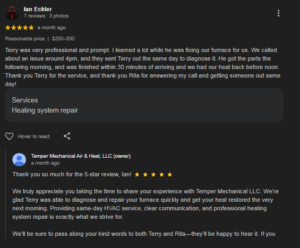
This is where Ian’s review about learning during the repair becomes important. Technical findings mean nothing if homeowners don’t understand them.
When our technicians finish diagnosis, they should explain in everyday language, not industry jargon. Instead of “Your flame sensor’s microamp reading is out of spec,” a homeowner-friendly explanation sounds like: “This metal rod sits in your burner flame. It needs to stay clean to work properly. Yours has corrosion buildup preventing it from sensing the flame, so your furnace thinks it’s unsafe to stay on and shuts down within a few seconds.”
Good explanations include showing you the problem when possible. Dirty flame sensors, cracked igniters, or corroded wiring become concrete when you can see them rather than just hearing descriptions.
Technicians should explain your options clearly. Sometimes repairs are straightforward with single solutions. Other times you have choices between repair and replacement, particularly when multiple problems exist or when systems are old enough that additional failures are likely soon.
Cost breakdowns should make sense. You should understand what you’re paying for labor versus parts, why specific parts cost what they do, and what warranty covers the work.
Questions should be welcomed, not treated as inconveniences. If something isn’t clear, asking for clarification should feel comfortable, not awkward.
What Diagnosis Costs and What It Includes
Furnace diagnosis in Richmond TX typically costs between $79 and $150 as a standalone service call. This fee covers the technician’s time, expertise, travel, and the testing that identifies your problem.
Many companies, including Temper Mechanical, apply this diagnostic fee toward repair costs if you proceed with recommended work. Essentially, diagnosis becomes free when you authorize the fix.
The diagnostic fee should include a clear written estimate for any repairs needed, not just a verbal quote you’re expected to remember. This written documentation lets you compare options if you’re getting multiple opinions and provides a record of what was agreed upon.
What diagnosis doesn’t include is speculation. You’re paying for answers based on actual testing, not guesses about what might be wrong. If a technician can’t definitively identify the problem, they should say so rather than recommending parts replacement based on hunches.
Red Flags During Diagnosis
Not all HVAC companies approach diagnosis professionally. Watching for warning signs protects you from poor service or dishonest practices.
Immediate replacement recommendations without diagnosis suggest the technician isn’t actually trying to fix your furnace but rather sell you a new one. Sometimes replacement makes sense, but that conclusion should follow diagnosis, not replace it.
Vague explanations that don’t specify what component failed or why indicate the technician either doesn’t actually know what’s wrong or isn’t willing to explain clearly.
Refusal to show you the problem when it’s something visible suggests they’re not confident in their diagnosis or are overstating issues.
Pressure tactics during diagnosis feel wrong because they are. “This price is only good today” or “Your system might not make it through winter” create artificial urgency designed to prevent you from thinking clearly or getting second opinions.
Diagnosis that takes suspiciously little time raises questions. Thorough furnace diagnosis requires testing and observation. A technician who arrives, spends five minutes, and declares your furnace needs major work probably didn’t actually diagnose anything.
After Diagnosis: Making Decisions
Once diagnosis is complete and you understand what’s wrong, you’re facing decisions about repairs, costs, and whether fixing your current furnace makes sense versus replacement.
For straightforward repairs on relatively new furnaces, the decision is easy. Fix it and move on.
For older furnaces needing expensive repairs, the calculation becomes more complex. Technicians should help you think through whether investing in a 15-year-old furnace makes financial sense when additional failures are statistically likely soon.
Good HVAC companies present options without pressure. They explain what they’d recommend and why, but they ultimately respect that you make the final decision about your home and your money.
What Richmond Homeowners Say About Our Diagnosis Process
The best way to understand what professional diagnosis looks like is hearing from homeowners who’ve experienced it. Ian’s review mentioned learning during the process. Patricia Jackson specifically praised our attention to detail. Herman Taylor appreciated that Jermaine explained what caused the problem clearly.
These aren’t isolated experiences. They reflect our standard approach to every diagnosis. You can read more reviews from Richmond, Sugar Land, Rosenberg, and Fort Bend County homeowners on our Google Maps listing where families share their actual experiences with our furnace diagnosis and repair services.
When Your Furnace Needs Professional Diagnosis
If your furnace isn’t heating properly, won’t start, or behaves unpredictably, professional diagnosis identifies the problem accurately so you can make informed repair decisions.
Call Temper Mechanical at (346) 485-8142 to schedule furnace diagnosis in Richmond TX. Our licensed technicians bring proper testing equipment, follow thorough diagnostic procedures, and explain findings in language that actually makes sense.
We serve Richmond, Sugar Land, Katy, Rosenberg, Pecan Grove, and throughout Fort Bend County with furnace service that treats your home and your understanding with respect.
Your furnace shouldn’t be a mystery. Professional diagnosis turns uncertainty into clear answers and informed decisions.