
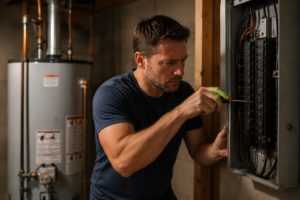
You reset the breaker, walk away, and a few minutes later it trips again. Or maybe it holds for a day and then trips again the next morning. Either way, you are stuck in a frustrating cycle, and deep down you already suspect this is not something you can just keep resetting forever.
You are right to think that. A breaker that trips once might be a fluke. A breaker that trips repeatedly is your electrical panel doing exactly what it is designed to do, protecting your home from a real problem happening inside your water heater. The breaker is not the issue. It is the messenger.
Here is what is actually going on, what you can safely check yourself, and when this becomes something that needs a licensed technician rather than another reset.
Why a Breaker Trips in the First Place
Before getting into causes, it helps to understand what a breaker is actually responding to. A circuit breaker trips when it detects either a current overload, meaning more electricity is flowing through the circuit than it is rated to handle, or a short circuit, meaning electricity is finding an unintended path, often through a failing component or damaged wiring.
Your electric water heater runs on a dedicated 240 volt circuit, and that circuit is sized specifically for the heater’s normal electrical draw. When something inside the unit starts pulling more current than it should, or when electricity starts leaking somewhere it should not be, the breaker trips as a safety measure to prevent overheating, electrical fire risk, or damage to your home’s wiring.
This means every time your breaker trips, something specific is happening inside that water heater. The five causes below cover nearly every situation we encounter.
Cause 1: A Failing Heating Element
This is the most common reason we find behind a repeatedly tripping water heater breaker, and it makes sense once you understand how these elements work.
Most electric water heaters have two heating elements, an upper element and a lower element, each controlled by its own thermostat. These elements sit directly in the water inside the tank and heat it through electrical resistance. Over years of use, elements gradually degrade. Mineral deposits build up around them, the metal casing can develop small cracks, and eventually the element can develop what is called a ground fault, where electricity leaks from the element into the water or the tank itself instead of staying contained within its intended path.
When this happens, the breaker senses that abnormal current and trips to protect the circuit. This is often the exact mechanism behind a breaker that trips consistently, sometimes within minutes of being reset.
How to know if this is your problem. If the breaker trips shortly after being reset, especially if it happens more consistently when the water heater is actively heating rather than sitting idle, a failing element is a strong possibility. You may also notice your hot water has become inconsistent or lukewarm in the weeks leading up to this, since a struggling element often shows performance issues before it fails completely.
What needs to happen. A failed element needs to be tested with a multimeter to confirm the ground fault and then replaced. This involves shutting off power to the unit, draining part of the tank, and safely working with electrical components submerged in water. This is squarely a job for a licensed technician, both for safety and to ensure the replacement is installed and sealed correctly.
Cause 2: A Faulty Thermostat
Each heating element is paired with a thermostat that regulates when the element turns on and off based on water temperature. When a thermostat fails, it can sometimes cause the element to draw power incorrectly or fail to cycle properly, which puts unusual strain on the circuit and can trigger a breaker trip.
This cause is sometimes confused with a failing element because the symptoms can look similar from the outside. The real difference typically comes out during testing, where a technician can determine whether the fault lies in the thermostat’s control function or the element’s electrical integrity itself.
How to know if this is your problem. If your water temperature has been inconsistent, running too hot at some times and too cool at others, alongside the breaker tripping, a thermostat issue is worth considering as a contributing factor.
What needs to happen. Thermostat replacement is a relatively straightforward repair once properly diagnosed, but like element replacement, it requires shutting off power safely and working inside the access panel of the unit. This should be handled by a professional.
Cause 3: Loose or Corroded Wiring Connections
Over time, the wiring connections inside your water heater’s junction box or at the breaker itself can loosen due to normal vibration, thermal expansion and contraction from repeated heating cycles, or general age. Loose connections create resistance at that connection point, which generates heat and can cause irregular current flow that the breaker interprets as a fault.
In homes with older wiring or water heaters that have been in place for many years without any electrical inspection, corrosion at connection points can create a similar effect, particularly in humid environments like garages or utility closets here in Fort Bend County.
How to know if this is your problem. This cause is harder to identify without opening the unit, but it becomes more likely if your water heater is older and has never had its electrical connections inspected. A slight burning smell near the electrical panel or discoloration around the wiring connections are signs worth mentioning to a technician if you notice them.
What needs to happen. This requires a visual and functional inspection of the wiring connections at the water heater and sometimes at the breaker panel itself. Tightening or repairing these connections is straightforward for a licensed electrician or HVAC technician but should never be attempted without cutting power to the circuit first and understanding what you are looking at.
Cause 4: A Bad or Weakening Breaker
Sometimes the problem is not the water heater at all. Breakers themselves have a functional lifespan, and after years of regular use, a breaker can become overly sensitive, tripping at current levels that are actually within a normal operating range for your water heater.
This is less common than a genuine water heater fault, but it happens often enough to be worth mentioning, particularly in homes with older electrical panels.
How to know if this is your problem. If a technician tests your water heater’s elements, thermostats, and wiring connections and everything comes back within normal range, yet the breaker continues tripping, the breaker itself becomes the leading suspect.
What needs to happen. Breaker replacement is an electrical panel repair, and depending on your panel type and local code requirements, this may need to be handled by a licensed electrician in coordination with your HVAC technician’s diagnosis.
Cause 5: The Circuit Is Undersized or Overloaded
In some older homes, or in homes where electrical work was done without proper permitting, the circuit powering the water heater may not be properly sized for the unit’s actual electrical demand. This is more common in homes that have had a water heater upgraded or replaced with a higher capacity unit without a corresponding electrical upgrade.
How to know if this is your problem. If your water heater was recently replaced with a different or larger model and the breaker tripping started around that same time, an undersized circuit is worth investigating. This is also more likely if your home has older electrical infrastructure that has not been updated in many years.
What needs to happen. This requires an electrician to verify the circuit rating against the water heater’s actual power requirements and potentially upgrade the wiring or breaker to properly match the unit. This is not a repair, it is a code compliance and safety issue that needs to be corrected properly.
What You Can Safely Check Yourself Before Calling Anyone
There are a few things worth ruling out on your own before assuming the worst.
Reset the breaker only once. If it trips again immediately or within a few minutes, stop resetting it. Repeatedly flipping a breaker that keeps tripping does not fix anything and can, in some cases, add unnecessary stress to a component that is already failing.
Check if other appliances are on the same circuit. In some homes, wiring was not done to code and a water heater ends up sharing a circuit with another major appliance. If you notice the breaker tripping specifically when another large appliance runs at the same time, this could point toward a shared circuit issue rather than a problem with the water heater itself.
Note when the tripping happens. Does it trip immediately after reset, or does it hold for a while and then trip during active heating? Does it happen consistently or randomly? This information is genuinely useful for a technician and can speed up the diagnostic process significantly when you call.
Do not attempt to open the water heater’s electrical access panel yourself. This involves exposed 240 volt wiring, and testing components safely requires proper tools and training. This is where DIY troubleshooting should stop.
Why This Is Not a “Wait and See” Problem
A breaker that trips once might be nothing. A breaker that trips repeatedly is a warning sign that should not be ignored, and here is why that matters beyond just the inconvenience of cold showers.
Ground faults and electrical shorts inside a water heater carry real fire and electrical shock risk if left unaddressed. Continuing to reset a breaker that keeps tripping does not resolve the underlying fault, it just delays the moment when the problem becomes more serious or more expensive to fix. In some cases, ignoring this issue can lead to complete element failure, tank damage, or in worse scenarios, actual electrical fire risk within the unit or surrounding wiring.
This is a situation where the cautious approach is also the correct one. If your breaker has tripped more than once on a water heater circuit, it is time for a professional inspection rather than another reset.
Getting This Fixed the Right Way
Diagnosing exactly which of these five causes applies to your situation requires testing with proper electrical equipment, not guesswork. A technician can identify whether the issue is a failing element, a faulty thermostat, a wiring problem, a weak breaker, or a circuit sizing issue, and fix the actual cause rather than leaving you to reset a breaker indefinitely.
If your electric water heater’s breaker keeps tripping, we can get a technician to your home, diagnose the exact cause safely, and walk you through what needs to happen next with clear, upfront pricing before any repair begins. If you are also noticing other symptoms alongside the breaker tripping, our full guide on how to fix a water heater and diagnose common problems can help you understand the bigger picture of what might be going on with your unit.
Call Temper Mechanical at (346) 485-8142
We serve Richmond TX, Sugar Land, Rosenberg, Pecan Grove, and all of Fort Bend County with same day water heater repair, upfront pricing, and licensed technicians who diagnose the real cause before recommending any fix.
Temper Mechanical Air & Heat LLC
6115 FM 762 Rd Suite 1200, Richmond TX 77469
Licensed. Bonded. BBB Accredited. Minority Business Certified. Flexible Financing Available.