
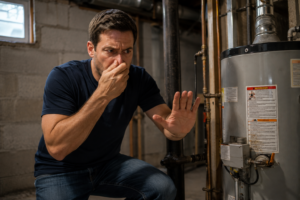
If you are reading this because you smell gas right now, stop reading and act first. Leave your home immediately, do not touch any light switches or electrical devices on your way out, and once you are safely outside and away from the house, call your gas utility provider’s emergency line. Their number is usually on your monthly bill or printed on your meter. If you cannot find it quickly, call 911.
Once you and your family are safe outside, come back to this guide if you want to understand exactly what to do next and why.
If you are here because you want to know what to do in case this happens, or you noticed a faint smell and are not sure if it is serious, keep reading. This information could genuinely matter one day.
Why Gas Water Heaters Have a Smell Built In
Natural gas and propane are actually odorless in their raw form. Utility companies add a chemical called mercaptan specifically because it gives gas a distinct, unpleasant smell often described as similar to rotten eggs or sulfur. This is intentional and it is one of the most important safety features in your entire home. Without that added odor, a gas leak could go completely undetected until it became a serious hazard.
This means if you smell that sulfur like odor near your water heater, your body is picking up on a warning system that was deliberately designed to get your attention. It is not something to second guess or wait out.
What To Do the Moment You Smell Gas
Do not touch any switches, including light switches, on your way out.
Flipping a switch, even to turn something off, can create a small electrical spark. In an environment with a gas leak, that spark is a genuine ignition risk. Leave lights, fans, and any electrical devices exactly as they are.
Do not light a match, use a lighter, or strike anything to see better.
This should go without saying, but in a moment of panic people sometimes act on instinct without thinking it through. Any open flame near a gas leak is dangerous.
Do not use your phone inside the house.
Cell phones and cordless phones can, in rare cases, generate a small spark. Wait until you are outside and a safe distance from the house before making any calls.
Leave doors and windows as they are on your way out.
Do not stop to open windows for ventilation. Getting everyone out safely and quickly matters more than trying to air out the house on your way through it.
Get everyone, including pets, out of the home immediately.
Move to a safe distance, ideally across the street or well away from the structure, not just onto the porch or driveway.
Do not go back inside for any reason.
Not for a phone charger, not for a pet you think might still be inside, not for anything. Once you are out, stay out until a professional confirms it is safe to return.
Call your gas provider’s emergency line from outside the home.
Most gas utility companies operate a 24 hour emergency response line for exactly this situation. If you are in the Richmond TX or Fort Bend County area and are unsure of your provider’s emergency contact, calling 911 will connect you with emergency services who can help coordinate a response.
Do not attempt to locate or fix the leak yourself.
Even if you feel confident about where the smell is strongest, do not try to inspect, tighten, or adjust any gas connections yourself while a leak is active. Leave this entirely to trained professionals with the right equipment.
What Happens After You Call
When you report a suspected gas leak, your utility provider typically dispatches a technician to your home quickly, often within the hour, specifically because of how seriously these calls are treated. They will use specialized gas detection equipment to locate the source of the leak, which may be coming from your water heater itself, a connection fitting, or the gas line leading to the unit.
In many cases, the gas company will shut off service to your home entirely until the leak is identified and repaired. This is a safety measure, not a punishment, and it means you may be without gas service, including hot water and potentially cooking gas, until the issue is resolved.
Once the utility company has confirmed the source and either repaired the immediate hazard or shut off gas flow safely, this is when a licensed HVAC or plumbing technician comes in to repair or replace the faulty component on your water heater itself.
What Actually Causes a Gas Smell Near a Water Heater
Understanding the common causes helps you know what a technician is likely to find, though this should never replace calling for help when you smell gas. Diagnosis and repair should always be handled by a professional.
A loose or failing gas connection fitting.
Over time, the fittings connecting your water heater to the gas supply line can loosen slightly due to vibration or general wear. Even a small gap at a connection point can allow gas to escape.
A cracked or deteriorated gas supply line.
Older flexible gas lines can develop small cracks or weak points over years of use, particularly in units that have never had a professional inspection.
A malfunctioning gas control valve.
The valve responsible for regulating gas flow to the burner and pilot can sometimes fail in a way that allows gas to leak rather than shutting off cleanly, particularly in older units.
Pilot light issues combined with gas buildup.
If a pilot light repeatedly fails to stay lit and gas continues to flow briefly before the safety mechanism shuts it off, small amounts of unburned gas can accumulate in the area around the unit, creating a noticeable smell even without an active mechanical leak.
Incomplete combustion.
In rare cases, a water heater that is not burning gas efficiently can produce a smell that gets mistaken for a leak. This still warrants a professional inspection since incomplete combustion carries its own risks, including carbon monoxide production.
How to Tell the Difference Between a Strong Smell and a Faint One
A strong, immediate, and unmistakable gas smell is always an emergency. Follow the steps above without hesitation.
A faint smell that you only notice occasionally, particularly right after the water heater cycles on, deserves serious attention but may not require the same immediate evacuation response. If the smell is faint and does not intensify, ventilate the area by opening a window if you can do so without using any switches, avoid using the water heater, and call a licensed technician to inspect the unit as soon as possible, ideally the same day. When in doubt, treat it as an emergency. It is always better to be overly cautious with gas.
Preventing Gas Leaks Before They Happen
Schedule annual water heater inspections.
A professional inspection includes checking gas connections, testing for leaks with proper equipment, and verifying that your unit’s combustion and venting are functioning correctly. This is one of the most effective ways to catch a developing issue before it becomes a genuine hazard.
Do not ignore a pilot light that repeatedly won’t stay lit.
If you have been dealing with a pilot light that keeps going out, this is not just an inconvenience. It can be an early indicator of a gas control valve or thermocouple issue that should be addressed by a professional rather than repeatedly relit on your own.
Install a carbon monoxide detector near your water heater and throughout your home.
While not a gas leak detector specifically, carbon monoxide detectors add an important layer of protection related to gas appliance safety, particularly for detecting issues related to incomplete combustion or venting problems.
Know where your gas shutoff valve is located before you need it.
Most homes have a main gas shutoff valve near the meter, along with a dedicated shutoff for the water heater itself. Knowing where these are and how to operate them means you are prepared rather than searching for them during an actual emergency.
Replace aging gas water heaters proactively.
Water heaters older than 10 to 12 years have a higher likelihood of developing connection and valve issues simply due to age. If your unit is approaching or past this range, a proactive inspection or replacement conversation is worth having before a problem develops rather than after.
After the Emergency Is Resolved
Once the gas company and a licensed technician have confirmed your home is safe and any necessary repairs have been completed, it is worth having a broader inspection of your water heater performed to understand why the leak happened in the first place and whether any other components show early signs of wear. A leak is rarely an isolated event on a unit that has otherwise been perfectly maintained. It is often a signal that the unit as a whole deserves a closer look.
If you recently went through this experience or want a professional inspection to make sure your gas water heater is operating safely, our team can perform a full safety check, verify all connections, and address any developing issues before they become a genuine hazard.
Call Temper Mechanical at (346) 485-8142
We serve Richmond TX, Sugar Land, Rosenberg, Pecan Grove, and all of Fort Bend County with same day service, licensed technicians, and thorough safety inspections you can trust.
Temper Mechanical Air & Heat LLC
6115 FM 762 Rd Suite 1200, Richmond TX 77469
Licensed. Bonded. BBB Accredited. Minority Business Certified. Flexible Financing Available.