
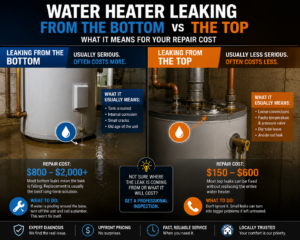
Here is the answer most people are looking for before they even call a plumber:
Leaking from the top: Almost always repairable. Most causes run $75 to $350 to fix. You probably have some time to get it sorted.
Leaking from the bottom: Often means the tank itself has failed internally. If that is the case, you are looking at replacement, not repair, and the cost runs $900 to $2,000 installed in Richmond TX.
But location alone does not tell the whole story. A leak from the bottom is sometimes just a faulty drain valve, which costs $100 to $200 to fix. A leak from the top near the pressure relief valve can indicate a serious pressure problem that needs same-day attention even though the valve itself is an inexpensive part.
This guide walks through every specific leak location, what it means, what it costs, and how urgently you need to act. Read the section that matches where your leak is coming from and you will have a clear picture before you pick up the phone.
If your water heater is actively flooding or you are seeing significant water accumulation, skip this guide and call Temper Mechanical at (346) 485-8142 right now. Our emergency plumbing team in Richmond TX is available around the clock.
Before You Do Anything Else: Locate the Leak Precisely
The most common mistake homeowners make when they see water around their water heater is assuming where the leak is coming from. Water follows gravity and travels along surfaces before dripping off at a low point. What looks like a bottom leak can be water that originated at the top and ran down the outside of the tank.
Before reading further, do this. Dry the entire outside of your water heater with a towel, including the pipes, connections, and sides of the tank. Then run a piece of toilet paper or a dry cloth along each connection point, starting at the very top and working your way down. The first spot that becomes wet is your actual leak source.
This single step prevents misdiagnosis and saves you from unnecessary cost estimates.
Leaking From the Top: What Each Location Means
There are four main locations where a water heater can leak from the top. Each has a different cause, a different cost, and a different urgency level.
Cold Water Inlet Pipe or Hot Water Outlet Pipe
The cold water inlet is the pipe that brings cold water into your water heater. The hot water outlet is the pipe that sends heated water to your taps. Both connect to the water heater at the top. Both are standard threaded connections or dielectric unions.
These connections can develop a slow leak for several reasons. The fitting may have vibrated loose over time. The threads may have corroded slightly, particularly in Fort Bend County’s hard water conditions where mineral scale builds up around metal connections. A dielectric union, which is the fitting designed to prevent corrosion between dissimilar metals, may have deteriorated.
What it looks like: A slow drip or damp mineral buildup around the top pipe connections. Sometimes a whitish mineral crust surrounds the fitting where water has been evaporating.
Urgency: Low to medium. This is not an emergency but leaving it allows further corrosion and the drip rate typically increases over time.
Cost to fix: Water heater leak repair costs $100 to $1,000 depending on the source of the leak. If water is leaking from a fitting, tightening the fitting or valve may solve the problem. For a loose pipe fitting specifically, a plumber can often tighten or reseal the connection for a diagnostic fee plus minimal labor. Fitting replacement runs $75 to $200 including labor. If a dielectric union needs replacing, expect $150 to $300. HomeGuide
Can you fix it yourself? Sometimes. If the fitting is visibly loose, tightening it carefully with a pipe wrench may stop the leak temporarily. Do not overtighten, which can crack the fitting. If tightening does not resolve it, call a plumber.
Anode Rod Port
The anode rod is a long metal rod that screws into the top of your water heater through a dedicated port. Its job is to corrode preferentially so your tank does not. After years of service the port where it screws in can develop a slow weep, particularly if the rod has not been replaced and the surrounding material has degraded.
What it looks like: A damp spot or slow drip at a hexagonal fitting on top of the tank, sometimes obscured by an insulation cover or sheet metal.
Urgency: Low to medium.
Cost to fix: Anode rod replacement including the new rod runs $150 to $300. This repair also restores the protective function of the rod, which matters significantly in Richmond TX where hard water consumes anode rods faster than in soft water areas.
Temperature and Pressure Relief Valve
The T&P valve is mounted on the side of the tank near the top and has a discharge pipe running down toward the floor. If this valve is dripping or releasing water, two different situations could be causing it.
The first is a worn valve that is no longer sealing properly when closed. T&P valves open when water temperature or pressure exceeds safe limits, and each activation causes slight wear on the internal seat. A valve that has opened multiple times may not fully reseat afterward.
The second is a genuine pressure or temperature problem inside the tank. When your expansion tank has failed or is absent, thermal expansion has nowhere to go. Pressure builds inside the water heater with every heating cycle and the T&P valve opens periodically to release it. In this case replacing the valve without addressing the pressure problem means the new valve will start doing the same thing within weeks.
What it looks like: Water dripping from the small lever or valve body itself, or water running down the discharge pipe even though you have not activated the lever manually.
Urgency: Medium to high. A T&P valve that is weeping because of genuine over-pressure is a safety concern. Do not cap or plug this valve under any circumstances.
Cost to fix: T&P valve replacement runs $100 to $250. If a failed expansion tank is the underlying cause, add $200 to $400 for the expansion tank. Both repairs together are far less expensive than the alternative of ignoring a pressure problem until something more significant gives way.
Leaking From the Bottom: What Each Location Means
A bottom leak causes more concern than a top leak for good reason. It often means the tank itself has corroded through internally. But before assuming the worst, check these two specific locations.
Drain Valve
The drain valve is located at the very bottom of the tank. It looks like a hose bib or a small plastic or brass faucet and is used to flush sediment from the tank. These valves can develop a slow drip at the valve body, particularly on older units where the plastic valve has degraded, or if the valve has been opened and closed for maintenance and the internal seal has worn.
What it looks like: A slow drip directly from the valve itself, not from the tank wall near the valve.
How to tell: Dry the area and watch closely. If the drip is coming from the valve body or the connection thread, it is the valve. If water is seeping from the tank wall around or near the drain valve, the tank is the source.
Urgency: Low to medium. A weeping drain valve does not require emergency response but should be addressed within a week to prevent water damage to the floor or cabinet area.
Cost to fix: Drain valve replacement runs $100 to $200 including parts and labor. The plumber drains the tank partially, replaces the valve, and refills the system. This is one of the more affordable water heater repairs.
The Tank Itself — Internal Corrosion
This is the diagnosis nobody wants but it is the most important one to understand clearly.
When the internal glass lining of a water heater tank develops cracks, which happens through thermal stress from sediment buildup and the repeated heating and cooling cycles the tank goes through over years of operation, the steel beneath begins to corrode. Once that corrosion progresses far enough, water seeps through the tank wall itself.
Water leaking from the bottom of the tank typically indicates damage to the tank itself, and the whole water heater must be replaced. HomeGuide
There is no patch, no sealant, and no repair for a tank that is leaking from the wall. The steel is compromised from the inside out, and once it starts leaking it will get worse, never better. The only question is whether it fails slowly enough that you can plan a replacement on your schedule, or whether it gives way completely and floods your utility room, garage, or attic before you have acted.
What it looks like: Water seeping or dripping from the lower side wall of the tank, pooling underneath the unit, or in some cases a small rust-colored stain on the tank exterior at the point of failure. The leak may be very slow at first and easy to miss until it worsens.
Urgency: High. A leaking tank should be replaced as soon as possible, ideally within 24 to 48 hours of discovery. A tank that is leaking slowly today can fail completely with no additional warning. When it does, depending on the tank’s location in your home, the water damage can be substantial.
Cost to fix: Leaking tanks typically require replacing the water heater for $600 to $1,800. In the Houston and Fort Bend County area, installed replacement costs run $900 to $2,000 depending on tank size, fuel type, and any required upgrades to connections, venting, or the expansion tank. Standard tank replacement of 40 to 50 gallon gas or electric units runs roughly $1,200 to $2,800 installed in the Houston area. HomeGuideHugo Plumbing
The Complete Cost Reference Table
Here is every leak scenario in one place with honest costs for Richmond TX and Fort Bend County in 2026.
| Leak location | Cause | Repair or replace | Cost range |
| Cold water inlet fitting | Loose or corroded connection | Repair | $75 to $200 |
| Hot water outlet fitting | Loose or corroded connection | Repair | $75 to $200 |
| Anode rod port | Worn seal or degraded port | Repair | $150 to $300 |
| T&P valve body | Worn valve | Repair | $100 to $250 |
| T&P valve (pressure-related) | Failed expansion tank | Repair both | $300 to $650 |
| Drain valve | Worn seal or plastic degradation | Repair | $100 to $200 |
| Tank wall or base | Internal corrosion | Replace | $900 to $2,000 |
Why Fort Bend County Homes See This Problem Sooner Than Most
Richmond TX water tests at 11.1 grains per gallon, which sits squarely in the very hard water category. Hard water accelerates almost every failure mode in this guide.
Sediment builds up at the bottom of the tank faster, creating greater thermal stress on the glass lining and accelerating the internal corrosion that leads to tank wall leaks. The anode rod that protects your tank gets consumed faster, often in 3 to 4 years instead of the 5 to 6 years that manufacturers design for in average water conditions. Mineral scale builds up around fittings and connection points, contributing to corrosion at the joints where top leaks most commonly originate.
The practical result is that water heaters in Richmond TX homes frequently reach failure conditions at 6 to 8 years rather than the 10 to 12 years that manufacturer specifications suggest. If your unit is in this age range and developing a leak, the repair versus replace calculation should account for the reduced remaining service life you can realistically expect.
Addressing the underlying water hardness with a whole-home water softener is the most effective way to slow this entire process. Our water filtration and softener services in Richmond TX are designed specifically for Fort Bend County’s water conditions and can meaningfully extend the life of a new water heater installed after your current one is replaced.
Repair vs Replace: Making the Right Financial Decision
When you call us, the first thing we assess is whether repair or replacement makes more financial sense for your specific situation. Here is the framework we use.
Replace makes sense when the tank itself is leaking, the unit is 10 years or older, or a repair would cost more than about half the price of a new heater. Hugo Plumbing
For a top leak on a unit under 8 years old in otherwise good condition, repair is almost always the right call. For a drain valve leak on any age unit, repair makes sense because the cost is modest and the repair addresses the entire problem. For a T&P valve leak, repair is appropriate unless the underlying cause is a systemic pressure problem combined with an aging unit that is showing other signs of wear.
For a tank wall leak regardless of age, replace. There is no version of this situation where repair is the right answer.
One additional consideration specific to Richmond TX: if your unit is between 8 and 10 years old and needs a repair that costs more than $400, run the 5,000 rule before approving the work. Multiply the unit’s age by the repair cost. If the result exceeds 5,000, replacement is usually the better investment.
For full detail on all the warning signs that precede water heater failure and how to recognize them early, our guide on signs your water heater is about to fail in Richmond TX covers every symptom and what each one means for your timeline.
What to Do Right Now Based on Your Leak Type
If you have a top leak at a pipe fitting or the anode rod port: Turn a towel under it to contain the drip. Schedule a service call within 2 to 3 days. This is not an emergency.
If your T&P valve is dripping: Call within 24 hours. Do not cap or ignore it. It may be a simple valve replacement or it may indicate a pressure problem worth diagnosing promptly.
If you have a drain valve leak: Place a bucket or towel underneath. Schedule within a week. Not an emergency but do not leave it indefinitely.
If water is coming from the tank wall or pooling under the unit and the source is the tank: Turn off the cold water supply valve above the unit now. For a gas unit, set the gas control to pilot. For an electric unit, turn off the breaker at the panel. Then call us. The longer a leaking tank runs, the greater the risk of a sudden complete failure and the water damage that follows.
Is a Tankless Water Heater Worth Considering for Your Replacement?
If replacement is where you are headed, this is the right moment to consider whether a tankless upgrade makes financial sense for your household.
Tankless units heat water on demand rather than storing and maintaining a tank of hot water continuously. In Fort Bend County’s hard water environment, a properly maintained tankless unit typically lasts 15 to 20 years compared to 6 to 8 years for a traditional tank in the same conditions. The higher upfront cost is often recovered through energy savings and extended service life within 4 to 6 years.
We currently offer a tankless water heater upgrade special for Richmond TX homeowners considering this option. If your current unit is heading toward replacement, it is worth a 10-minute conversation about whether tankless makes sense for your household size and usage patterns before committing to a like-for-like replacement.
Temper Mechanical Serves Richmond TX and All of Fort Bend County
We are a family-owned plumbing and HVAC company based in Richmond TX. When you call us about a water heater leak, we diagnose it honestly, show you what we found, give you the price before touching anything, and tell you straight whether repair or replacement is the right call for your specific situation.
We do not recommend replacement when a repair will do the job, and we do not recommend repair when the tank has failed and replacement is inevitable.
4.9 stars from 165 Google reviews from your neighbors throughout Richmond, Sugar Land, Rosenberg, Pecan Grove, and Cinco Ranch.
Call Before the Leak Becomes a Flood
A leaking water heater that is caught early and diagnosed correctly is a manageable situation. One that is ignored until the tank fails completely is a much more expensive and stressful one.
Call Temper Mechanical now: (346) 485-8142
Same-day water heater repair and replacement available throughout Richmond TX, Sugar Land, Rosenberg, Pecan Grove, Cinco Ranch, and Fort Bend County. We answer 7 days a week.
Not ready to call? Fill out our quick form below and we will call you back within 15 minutes.
Temper Mechanical Air and Heat LLC | 6115 FM 762 Rd Suite 1200, Richmond TX 77469 | (346) 485-8142