
If your condensate pump is not working, the cause is usually one of four things: no power, a slimy or stuck float switch, a blocked or kinked discharge line, or a dead motor. The first three are often fixable in 20 minutes with soap, water and a flashlight. A dead motor means a replacement. Either way, shut the AC or furnace off first, because every minute it runs sends more water into a pump that cannot move it.
This guide walks through the checks in the order a technician would run them. It covers a pump that is silent, one that runs and runs, one that is noisy, and one that overflows. It also says plainly where DIY should stop.
TL;DR
- Turn off the AC or furnace at the thermostat before you touch anything, then unplug the pump.
- Most “dead” pumps are dirty, not broken. Cleaning the reservoir and float with mild soap and water often brings them back.
- A pump that runs but moves no water points to a kinked hose, a blocked line, a stuck check valve or too much vertical lift.
- A silent pump with a full reservoir, after cleaning and a power check, is likely a motor or wiring failure. Call a licensed technician.
- A pump in an attic or crawl space should shut the system down when it fails. If yours does not, have the safety wiring checked.
Table of Contents
- What a condensate pump does
- Before you do anything: make it safe
- Condensate pump troubleshooting, step by step
- Condensate pump overflowing: what it means
- Condensate pump noise: normal, annoying or a warning
- The safety switch you should not ignore
- When cleaning is not enough
- What a repair costs
- Our perspective: treat the pump as part of the drain system
- Keep the pump from failing again
- When you want it handled
- FAQ
- Sources
What a condensate pump does
Your air conditioner pulls humidity out of the air, and in a Texas summer that is a lot of water. Where the indoor unit sits below the drain, or too far from one, a small pump collects the water in a reservoir. A float rises with the water level and switches the pump on. The pump pushes the water out through a small discharge tube to a drain, a sink or the outdoors. High-efficiency furnaces make condensate too, so the same pump can serve heating.
Two parts fail most: the float switch (it sticks) and the motor (it burns out). Everything else is a supporting cast: the power cord, the inlet, the check valve and the discharge hose.
Before you do anything: make it safe
Water and electricity share a closet in this setup. Do these steps first:
- Set the thermostat to off, so no more condensate arrives.
- Unplug the pump or switch off its breaker before you reach into the reservoir.
- Put a towel and a shallow container under the work area. If the reservoir is full, you will spill some.
- Note whether water has reached the unit, the floor or a ceiling below. Photograph it. You may need it for a home insurance conversation.
If you see water near wiring, hear buzzing, or smell burning, stop and call someone. That is no longer a cleaning job.
Condensate pump troubleshooting, step by step
1. Check power
It sounds too simple, and it is the check people skip. Confirm the cord is seated, the outlet works (plug in a lamp), and the breaker has not tripped. Some pump manuals ask for a dedicated circuit. The Little Giant VCMA installation manual, for example, says to wire the pump to its own circuit with no other receptacles or equipment on it. A pump sharing a circuit with a space heater or a freezer can trip repeatedly.
On some new pumps, a cardboard tab holds the switch in place for shipping. Little Giant’s support page for the VCMA lists removing that tab among the first things to check when a new pump will not turn on.
2. Look at the reservoir and float
With the pump unplugged, remove the cover and look inside. In a humid climate like ours, slime, algae and sludge grow in the tank and can clog the float or the sensor. Beckett’s maintenance guide advises removing and cleaning the tank when a pump works in a dirty environment. Hartell lists routine maintenance as critical too.
What to do:
- Empty the tank into a bucket.
- Wipe the tank, the float and the inlet with mild soap and warm water.
- Move the float by hand and check that it rises and drops freely.
- Do not bend, pry or force the float or the switch. Gentle is the rule.
- Reassemble, plug in, and pour a little water in to test.
If the float now clicks and the pump runs, you just saved yourself a service call.
3. Follow the discharge line
A pump that hums or runs but does not empty the tank usually has a discharge problem. Hartell’s troubleshooting guide says a pump that never switches off is typically unable to push the water out, because of a kinked or blocked hose, a stuck check valve, or a vertical lift beyond what the pump is designed for.
Walk the tube from the pump to where it ends:
- Kinks: a tube bent behind a duct or squeezed by stored boxes.
- Blockage: slime or debris in the line. Disconnect it and see whether water flows freely.
- Check valve: this small one-way valve sits near the pump outlet. If debris holds it shut, water has nowhere to go. Remove it, rinse it, and check that it opens in the flow direction.
- Lift and distance: a pump rated for a given height will struggle if the line climbs higher or runs farther than planned. This usually shows up on a new install or after a rerouting, not on a pump that worked fine for years.
4. Test with water
Plug the pump in and pour a quart of water slowly into the reservoir. A healthy pump starts when the float lifts, empties the water, and shuts off. Possible results:
| What happens | Likely cause | Next step |
|---|---|---|
| Nothing, no sound, tank full | No power, dead motor, failed switch | Recheck power; if fine, call a pro |
| Hums, no water moves | Jammed impeller, blocked line, stuck check valve | Clean the inlet and line, rinse the valve |
| Runs and moves some water, never stops | Blocked or kinked discharge, too much lift | Trace the line, clear it |
| Runs after the tank is empty | Float stuck up | Clean the float; replace the pump if it stays stuck |
| Short cycles | Check valve leaking back, partial blockage | Inspect valve and line |
Condensate pump overflowing: what it means
Water on the floor does not automatically mean a dead motor. Service professionals point out that leaks near the indoor unit often trace to a blocked inlet, a stuck float or a kinked discharge line, not a failed motor. That is why the cleaning steps come first.
If the pump is overflowing right now:
- Turn the system off at the thermostat and the breaker.
- Unplug the pump and soak up the water.
- Check the drain line leading into the pump. A clogged AC drain line upstream sends more water than expected into the reservoir, and the pump may be fine.
- Dry the area completely, including under the unit and any insulation.
Water that sat on drywall or insulation for more than a day or two can grow mold. If you see staining on a ceiling below an attic unit, treat it as a bigger problem than the pump.
Condensate pump noise: normal, annoying or a warning
A brief hum when the pump kicks on is normal. These are not:
- Loud buzzing with no water moving: a jammed impeller or a blocked outlet. Unplug it. Do not let it run dry or against a blockage, since the motor heats up.
- Rattling or gurgling: air in the line, a loose pump on its mount, or a tube vibrating against a joist or duct. Re-secure the pump and cushion the line.
- Grinding or screeching: worn motor bearings. Replacement territory.
- Constant short bursts: often a leaking check valve letting water drain back into the tank, so the pump keeps refilling the line.
A pump that has become noticeably louder than it used to be is telling you it is on its way out.
The safety switch you should not ignore
A pump failure should not turn into a ceiling collapse. Many pumps carry an overflow switch that cuts power to the AC or furnace if water rises too high. The International Code Council describes this as a code requirement: the 2015 mechanical code section on condensate pumps says pumps in uninhabitable spaces such as attics and crawl spaces must be connected so the equipment cannot run when the pump fails. The ICC’s note adds that these float controls are often left unconnected, or the pump may lack an overflow switch. Which code edition applies to your home depends on your local jurisdiction and when the system was installed.
Here is the practical test: if water filled the reservoir or spilled and your AC kept cooling, the safety wiring probably is not working. Do not fix this yourself by guessing at low-voltage wires. A technician can verify the overflow switch is wired into the equipment’s control circuit, which is a quick job during any visit.
If the pump sits above a finished ceiling, a secondary drain pan under the coil is also worth having, so a failure drips into a pan and not into your living room.
When cleaning is not enough
Call a licensed technician when:
- The reservoir is full and the pump stays silent after you cleaned it and confirmed power. This points to a motor or electrical failure, and Beckett’s guidance is that DIY effort should not go further than basic cleaning.
- The float does not move freely even after cleaning.
- The pump trips a breaker.
- Water reached the AC’s electrical parts.
- The AC did not shut off during an overflow.
- You see signs of past leaks (stains, swelling drywall, musty smell). Our guide to what your AC smell is telling you covers the mildew case.
If your AC is also struggling to cool, the pump may be a symptom, not the cause. See why your AC isn’t cooling for the checks that come next.
What a repair costs
A pump problem is often cheap to fix, and the price depends on what the technician finds. Our published ranges for Richmond, TX:
| Service | Published range |
|---|---|
| Diagnostic Visit | $75-$150 |
| Condensate Drain Clearing | $75-$200 |
| Evaporator Coil Cleaning | $150-$400 |
| Thermostat Replacement | $150-$400 |
| Capacitor Replacement | $150-$400 |
A clogged line is the cheap end. We don’t list a separate pump replacement price, so ask for a quote after the diagnosis. We’d rather tell you the problem is a clogged line than sell you a new pump. If the drain keeps clogging, we’ll point to the algae source in the coil or line.
Our perspective: treat the pump as part of the drain system
We see the same pattern every summer in Richmond and Sugar Land: a homeowner calls about a dead pump, and the pump is a symptom. Slime in the line, a coil that needs cleaning, a hose bent when somebody stacked holiday decorations in the attic. Replacing the pump without fixing the cause means a second call in six weeks.
So our approach is simple. We check power, float, line and safety switch in that order, tell you what we found in plain words, and quote before we replace anything. A new pump is sometimes the right answer, and we say so when it is. When a $75 drain clearing solves it, we say that instead.
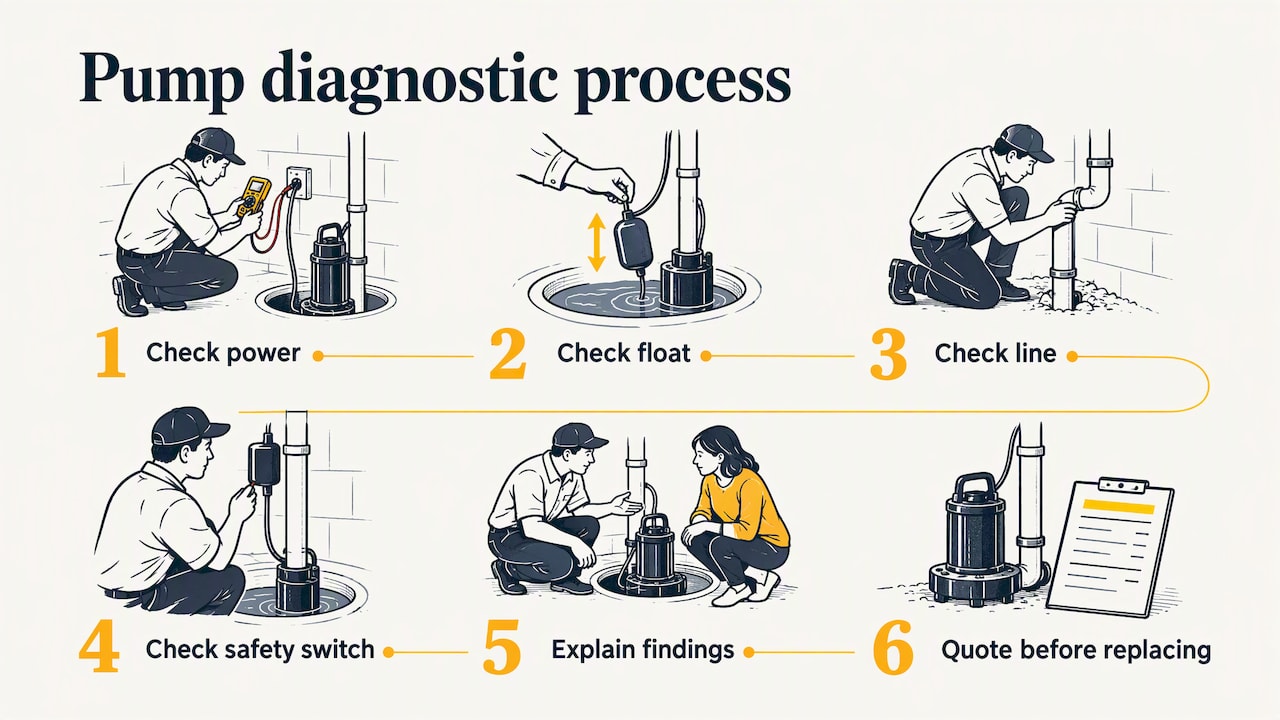
The other thing we push is the safety switch. We have no patience for an attic pump that can flood a ceiling without shutting the AC down. It is cheap protection, and checking it takes minutes.
If you have a system more than a few years old, a yearly tune-up is the real fix. Cleaning the pump and drain is part of what a maintenance visit should cover.
— Wally
Keep the pump from failing again
- Clean it twice a year. Beckett’s guidance recommends servicing once or twice a year, ideally at the start and end of cooling season. In our humid Gulf Coast climate, lean toward twice.
- Rinse the reservoir with mild soap and water. Skip harsh chemicals unless the pump manual allows them.
- Test the float each spring by pouring water in and watching the cycle.
- Keep the line clear of kinks and stored items.
- Add a secondary pan under the coil if the unit is above living space.
- Know the age. Pumps wear out. If yours is noisy, hot or cycles oddly, replace it before it fails in July.
Our signs you need an HVAC tune-up guide explains what a good visit covers.
When you want it handled
If you cleaned the pump and it is still dead, still overflowing or still loud, we can diagnose it. Temper Mechanical Air & Heat is a locally owned Richmond, TX company with NATE-certified, licensed technicians, 24/7 emergency repair and transparent pricing. A diagnostic visit runs $75-$150, and we explain the fix before we do it.
If the pump failed during a heat wave and water is on the floor, our emergency AC repair guide tells you what to do while you wait. To stop this happening every summer, look at our HVAC maintenance plans.
FAQ
How do I know if a condensate pump is working?
Listen and watch when the AC runs. You should hear the pump start briefly as the reservoir fills, and water should flow through the discharge line to its outlet. To test it safely, pour a quart of water slowly into the reservoir with the system off. A healthy pump starts, empties the water and shuts off.
Why does my condensate pump run all the time?
It usually cannot get rid of the water. Hartell lists a kinked or blocked discharge hose, a stuck check valve, or too much vertical lift as typical reasons. A float stuck in the up position will do the same thing. Turn the system off and trace the line before the motor overheats.
Can I keep running my AC with a broken condensate pump?
No. The AC keeps producing water, and with nowhere to go it overflows into the closet, attic or ceiling. Switch the system off until the pump works or a technician has looked at it. A working overflow safety switch would shut the system down for you, so if yours did not, get that checked.
How often should I clean a condensate pump?
Once or twice a year is the usual advice from manufacturers. Hartell says more often in high-humidity or dusty settings. Before and after cooling season is a simple schedule, and Southeast Texas humidity argues for sticking to both.
When should I replace the pump instead of repairing it?
Replace it when it stays silent with a full tank after cleaning and a power check, when the motor grinds or overheats, or when the float will not move freely even when clean. A technician can confirm before you spend money on a part.
Sources
- Residential AC Condensate Pump Troubleshooting, Hartell
- Basic Condensate Pump Maintenance & Troubleshooting, Beckett
- Condensate Pumps, 2015 code change summary, International Code Council
- Little Giant VCMA Series manual
- VCMA condensate pump FAQ, Little Giant
- Condensate Pump Not Working, condensatepump.co.uk