
Duct sweat is condensation. It forms when humid air touches a duct or vent surface that is colder than the air’s dew point. In a humid place like Richmond, TX, the usual culprits are missing or damaged insulation, leaky ducts, an air handler that moves too little air, or indoor humidity that is simply too high. Some of those you can check in an afternoon. Others need a technician with a hygrometer, a flashlight and a look at the hidden side of the duct.
This guide explains what is physically happening, how to tell which cause you have, what a fix usually costs, and where a DIY check should stop.
TL;DR
- Ducts sweat when the surface temperature drops below the dew point of the surrounding air. Humidity and cold surfaces are always both involved.
- The most common causes: torn or poorly sealed insulation, duct leaks, high indoor humidity, a dirty coil or weak airflow, and air leaking into the attic.
- Safe checks: read your indoor humidity, look at the insulation you can see, and check the drain line and filter. Don’t tear into attic insulation or wrap ducts with ordinary fiberglass.
- Call a pro if the sweating comes back, drips onto a ceiling, or you see mold or wet insulation.
Table of Contents
- What is actually happening when ductwork sweats
- Sweating vents versus sweating ducts: the dew point test
- The most common causes
- Safe checks you can do today
- Will a dehumidifier stop condensation on ductwork?
- What a professional fix involves
- Why sweating ducts are worth fixing
- Our perspective: fix the cause, not the drip
- Need someone to find the source?
- FAQ
- Sources
What is actually happening when ductwork sweats
Every condensation problem has one cause: humid air in contact with a cold surface. Your supply ducts carry air that your air conditioner has chilled, often to the low or mid 50s °F. The metal or flex duct wall takes on that temperature. If the air outside the duct, in your attic, a closet, a wall cavity or the room itself, carries enough moisture, its dew point sits above the duct surface temperature, and water beads up like it does on a glass of iced tea.
That is why a duct can be dry for weeks and then sweat on a single muggy afternoon. Industry writers note that sweating tends to show up during transitions, such as system startup or when doors are opened and warm, wet air suddenly floods a cooled space. A dripping duct on a rare day is not an emergency. A duct that sweats every cooling season is telling you something about your insulation, your moisture control, or both.
Two details matter for diagnosis:
- The duct itself is rarely the failure. HVAC professionals describe sweating as a symptom of an imbalance between what the system is doing and the conditions around it.
- The face of the vent can mislead you. The real moisture problem is often on the hidden side, at the boot in the attic or inside a wall cavity, where insulation may be torn, missing or badly installed.
Sweating vents versus sweating ducts: the dew point test
Before you blame the duct, find out which side of the equation is off: the cold surface or the humid air. A simple dew point reading helps.
According to Energy Vanguard, if the indoor dew point is close to 55°F, your supply air is probably too cold, often from low airflow or a refrigerant problem. If the indoor dew point is well above 60°F, the main problem is excess indoor humidity that needs dehumidification or better ventilation control.
| What you measure | What it suggests | Typical next step |
|---|---|---|
| Indoor dew point near 55°F, vents feel very cold | Supply air too cold: low airflow, dirty coil, refrigerant issue | AC diagnostic |
| Indoor dew point above 60°F | Too much moisture in the house | Humidity control, ventilation and air sealing |
| Normal indoor humidity but sweating only in the attic or a closet | Damaged insulation, duct leaks, or humid air getting in | Duct inspection |
| Sweating only at one register | Local insulation gap or air leak at the boot | Duct inspection |
A cheap digital hygrometer from a hardware store gives you relative humidity, and many models also calculate dew point. Read it in the middle of the house, not next to the bathroom or kitchen.
The most common causes
Insulation that is torn, thin or not vapor-sealed
Insulation on a cold duct does two jobs: it keeps the outer surface warmer and keeps moist air away from the cold metal. If it is torn, compressed, missing at joints or bunched at the boots, humid air reaches bare cold surfaces and water forms there.
The vapor barrier matters as much as the wrap. EPA guidance on duct cleaning is blunt that moisture should not be present in ducts. Professionals stress that insulation must be properly vapor-sealed: if humid air gets through the wrap and reaches the cold surface, the insulation becomes a sponge that holds water and can lead to mold and rot. That is why a roll of ordinary, unsealed fiberglass from a big-box store is not a lasting fix.
Leaky ducts
Leaks at seams and boots let conditioned air escape into the attic, which starves the rooms of cooling and pushes cold air against surfaces it should never touch. Leaks can also pull humid attic air into return ducts. If you want a sense of how leak and insulation diagnosis is priced, Angi reports that a professional inspection for duct leaks typically ranges from $100 to $750 as of 2025, depending on system complexity and access.
High indoor humidity
The EPA recommends keeping indoor relative humidity between 30% and 50%, and notes that humidity consistently above 60% supports mold and other biological growth. If your house sits at 60% or higher while the AC runs, ducts and vents will sweat, and so will windows and cold walls. Common sources in our area include an oversized AC that cools quickly but cycles off before it removes moisture, long showers without exhaust fans, and open doors during humid weather.
Air leaking into the attic or a closet
Uncontrolled air infiltration is a hidden cause. EPA’s mold and moisture guidance describes how a space with significant air leakage, such as where the roof meets an exterior wall, lets moist outdoor air hit the cold duct and creates a continuous local condensation problem. Changing the thermostat or the filter will not fix that. Owners often blame the HVAC unit when the building envelope is the culprit.
Roofing contractors see the same physics from above. A German roofing company’s guide to condensation in roof structures shows how warm, moist air meeting a cold surface in an attic space leads to damp materials, which is the same mechanism you are fighting on your ducts.
A dirty coil or weak airflow
A clogged evaporator coil or a dirty filter restricts airflow. That makes the air leaving the coil colder, which pulls the duct surface temperature down faster. EPA materials also note that dirty cooling coils can become a breeding ground for mold that then travels through the ductwork. If you notice sweating together with weak airflow, ice on the indoor unit, or a musty smell, the coil is a prime suspect. Our guide to AC smells like mildew covers that overlap.
Fan speed plays a role too. HVAC School points out that lower fan speeds make a colder vent while removing more moisture from the air, so technicians balance comfort and dehumidification when setting blower speed. That is a job for someone who can measure airflow, not a dial to turn at random.
Ducts buried under attic insulation
Burying ducts in blown attic insulation is tempting for energy savings, but it raises condensation risk. Federal Building America research on a Central Florida retrofit home examined buried duct condensation, and found that the practice is higher risk in hot-humid climates, especially at low thermostat settings such as below 75°F. Southeast Texas is a hot-humid climate, so treat that as relevant if your ducts are buried.
Safe checks you can do today
These take little time and don’t require crawling through insulation.
- Read your indoor humidity. Aim for 30% to 50%. Anything near or above 60% points to a moisture issue beyond the duct.
- Change the air filter. A clogged filter is the simplest airflow restriction.
- Check the condensate drain. A backed-up line can leave the air handler wet and raise humidity near the unit. Clearing a condensate drain on our schedule runs $75 to $200.
- Look at what you can see. Open the attic hatch and shine a light. Look for wet or discolored insulation, bare patches, or crushed flex duct. Don’t walk off the joists.
- Feel the joints. If you can feel air leaking at seams or boots with your hand while the system runs, note where.
- Note when it happens. Is it only on the most humid days, only in one room, or only after the system has run a long time? Write that down for the technician.
What not to do: don’t wrap ducts with duct tape and household insulation, and don’t turn the thermostat way down to try to dry the house. Overcooling pushes duct surfaces even colder.
If you find mold, or water has stained a ceiling, stop DIY and book an inspection. Ceiling drywall that stays wet is a material and health problem, not a cosmetic one.
Will a dehumidifier stop condensation on ductwork?
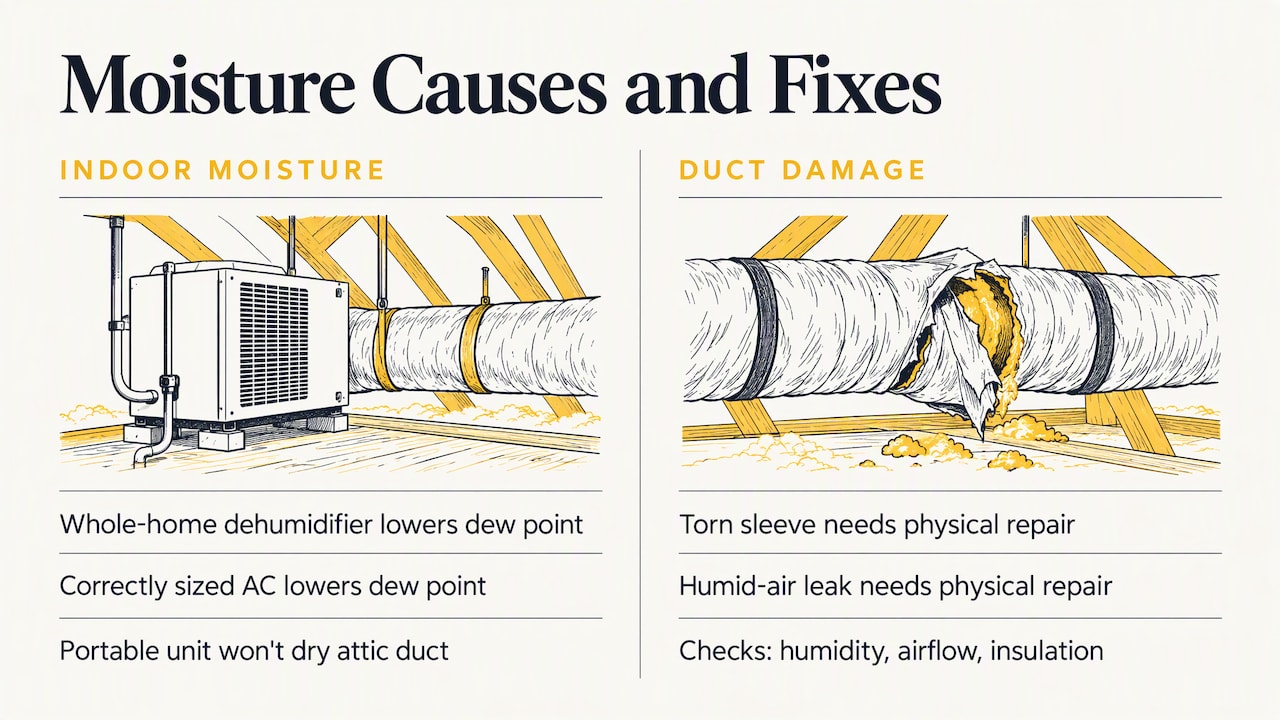
It can, when the cause is excess indoor moisture. A whole-home dehumidifier or a correctly sized, properly running AC pulls the dew point down, which helps every surface in the house. It won’t help if the problem is a torn insulation sleeve in the attic or humid air leaking in from outside: those need the physical fix. That is why a technician should look at humidity, airflow and insulation together rather than treating one number. A portable dehumidifier in a living room does nothing for a duct in a hot attic.
What a professional fix involves
The repair depends on the cause, and a good contractor will tell you which one it is before quoting.
- Replace or re-wrap insulation with proper vapor-sealed duct insulation, and seal joints and boots.
- Seal duct leaks at seams and connections.
- Clean the evaporator coil and clear the drain so air moves properly and nothing backs up.
- Correct airflow and refrigerant issues if the supply air is far too cold.
- Control humidity through dehumidification, ventilation fixes or better sizing.
- Air-seal the attic or closet where outdoor air is getting to the ducts.
- Replace badly damaged duct runs when insulation is soaked and moldy.
On our published price ranges, typical related line items look like this:
| Service | Published range |
|---|---|
| Diagnostic visit | $75 to $150 |
| Condensate drain clearing | $75 to $200 |
| Evaporator coil cleaning | $150 to $400 |
| Thermostat replacement | $150 to $400 |
| Refrigerant leak repair and recharge | $250 to $1,500 |
These are ranges, and the final price depends on access and what we find. Duct insulation and sealing work is quoted after an inspection, since attic access and duct length vary so much from house to house.
Why sweating ducts are worth fixing
Drips from a duct can soak attic insulation, stain ceilings and feed mold. Wet insulation also stops insulating, so your system works harder to cool the house. Mold spores can spread through the air system, and for households with allergies, that is a real concern. If you have already had musty odors or allergy flare-ups in humid months, our guide on indoor air quality in humid months explains the connection. If mold is already in the duct system, air duct cleaning comes after the moisture source is fixed, never before.
Our perspective: fix the cause, not the drip
We see a pattern in humid Texas homes: people treat the wet duct as the problem. Usually it is the clue. A wet duct tells us the system, the insulation and the house disagree about moisture, and our job is to find where.
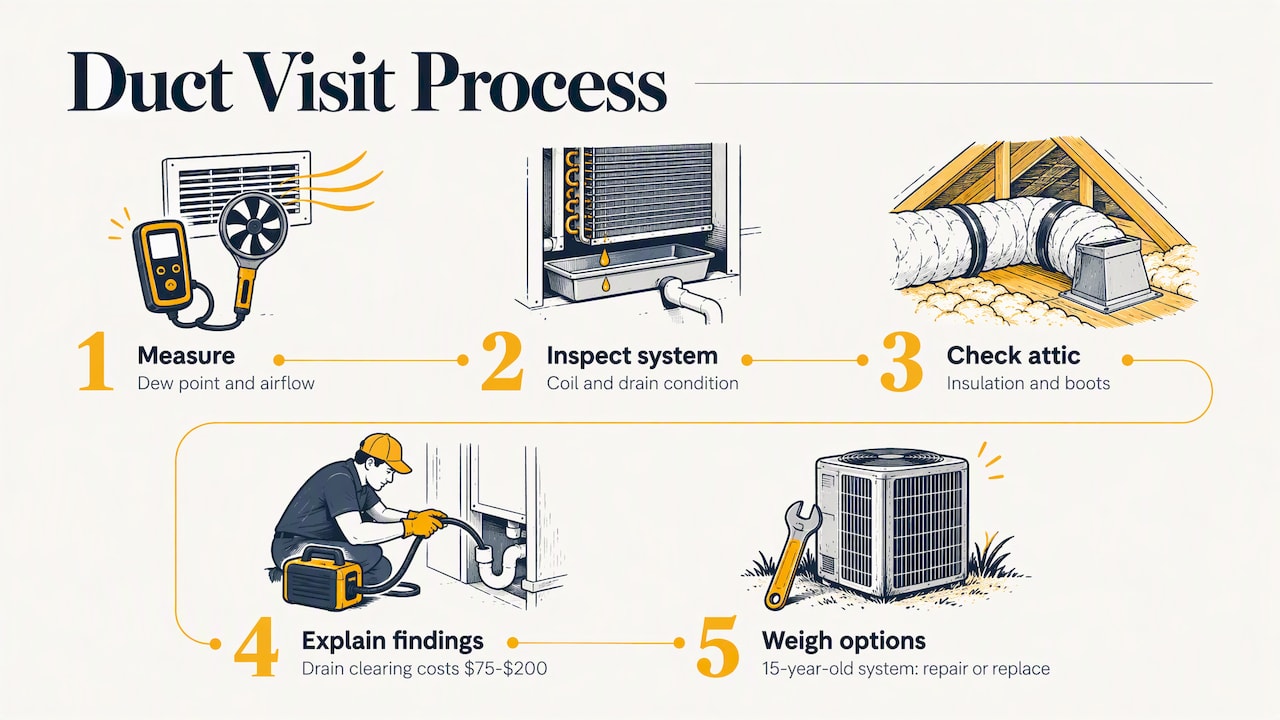
That is why a sweating-duct visit with us starts with measurements rather than a sales pitch. We want the dew point, the airflow, the condition of the coil and the drain, and a look at the insulation and boots in the attic, where the real damage tends to hide. If the answer is a $75 to $200 drain clearing, we tell you that. If the answer is that your 15-year-old system is struggling to keep up, we show you the numbers and let you weigh repair against replacement, using our repair vs replace guide as a starting point.
As a locally owned, minority-certified company with NATE-certified technicians, we treat every home like our own. That means no tearing into your insulation unless we have to, and no covering a moisture problem with a cosmetic wrap.
— Wally
Need someone to find the source?
If your ducts keep sweating, start with a diagnostic visit, published at $75 to $150. We check humidity, airflow, coil and drain, and insulation, then give you a clear explanation and a transparent price before any repair work. New customers can also look at our $50 new customer special. If you want to prevent the next muggy-season surprise, our maintenance plans put coil, drain and airflow checks on a schedule.
FAQ
Is it normal to have condensation on ductwork?
A little on an extremely humid day, especially at system startup, can happen and isn’t a crisis. Regular or heavy sweating is not normal. It points to insulation damage, leaks, airflow trouble or too much humidity, and it deserves an inspection before it stains a ceiling.
Why are my AC vents sweating inside the house?
The vent face is colder than the room air’s dew point. That usually means the supply air is too cold because of weak airflow, a dirty coil or a refrigerant issue, or the house is too humid. Measure your indoor humidity first: if it is above about 60%, moisture control is your first job.
How do I get ductwork to stop sweating?
Match the fix to the cause: re-insulate with vapor-sealed material, seal leaks, restore airflow with a clean filter and coil, and bring humidity into the 30% to 50% range. If you can’t identify the cause from the attic, have a technician diagnose it, since the worst damage is often on the hidden side of the duct.
Is sweating ductwork a sign I need a new AC?
Not usually. Most cases trace back to insulation, sealing, humidity or a maintenance issue. A replacement conversation makes sense only when diagnostics show a failing or badly oversized system, and then you should compare repair and replacement costs side by side.
Can sweating ducts cause mold?
Yes, if the moisture persists. Wet insulation and damp surfaces can support mold growth, and the air system can carry it through the house. If you see dark growth, smell mustiness or find wet insulation, schedule an inspection promptly.
Sources
- Why Do Air Conditioning Vents Sweat? (Energy Vanguard)
- Drip Happens in Ductwork Systems (ACHR News)
- Why Is My AC Vent Sweating? (The HVAC Engineer)
- Should You Have the Air Ducts in Your Home Cleaned (EPA)
- Condensation on Ductwork: Causes and Potential Solutions (Angi)
- Mold Course Chapter 2 (EPA)
- Mold and Moisture Control in Schools Q&A (EPA)
- Why Air Conditioning Ducts, Units, and Vents Sweat (HVAC School)
- Measured Cooling Performance and Potential for Buried Duct Condensation (U.S. DOE Building America)
- Kondenswasser im Dachstuhl (Engels Bedachungen)