
If your heater won’t turn off, the cause is usually one of two things: a thermostat setting or wiring problem, or a failed part inside the furnace, such as a stuck relay or a bad limit switch. The first you can check in ten minutes. The second needs a licensed technician. This guide walks through both, in the order we’d check them, and tells you where to stop and call.
TL;DR
- First check the thermostat: set it to Heat, set the fan to Auto, and drop the temperature well below the room temperature. If the system doesn’t stop, the problem isn’t your settings.
- A furnace that keeps running after you cut power to the thermostat or remove it from the wall points to internal parts (limit switch, relay, contactor). That is a professional repair.
- A dirty filter, a badly placed thermostat, or leaky ducts can make a furnace run long cycles, but they rarely cause a true “never shuts off” problem.
- If a carbon monoxide alarm sounds, or you smell something burning, shut the system down, get everyone outside and call for help before using it again.
- Published Temper Mechanical pricing: a diagnostic visit is $75-$150, and furnace repair is $150-$600.
Table of Contents
- First, Work Out What “Won’t Turn Off” Means
- Quick Checks You Can Do Safely at the Thermostat
- The Test That Tells You If the Furnace Itself Is at Fault
- Common Reasons a Furnace Won’t Shut Off
- When It Runs Nonstop but the House Won’t Warm Up
- Safety: When to Shut It Down and Leave
- What the Repair Usually Costs
- Our Perspective: Why Running Nonstop Is Rarely “Just a Thermostat”
- Get It Diagnosed Before Small Becomes Expensive
- How to Prevent It Next Winter
- FAQ
- Sources
First, Work Out What “Won’t Turn Off” Means
People use the phrase for three different situations, and each has a different fix.
- The blower fan runs nonstop, but the air is not hot. Often a fan setting or a limit switch issue.
- The burners and heat keep running past the set temperature. The house gets uncomfortably warm. This points to the thermostat, its wiring, or a control component stuck in the “call for heat” position.
- The furnace runs almost all the time but the house never gets warm. This is a capacity or airflow problem, not a switch that won’t open. It’s the situation behind searches like “furnace runs constantly.”
Note which one you have before you touch anything. It will save you time on the phone with a technician, and it narrows the cause quickly.
Quick Checks You Can Do Safely at the Thermostat
These checks involve nothing more than buttons and a screen. Don’t open the furnace cabinet, and don’t touch gas lines or wiring.
Check the mode and the fan setting
Set the thermostat to Heat and the fan to Auto. Repair Clinic’s furnace guide points out that with the fan on “On,” the blower runs continuously by design. That is the single most common false alarm.
Smart thermostats add another trap. Some have a circulate or humidity-related fan setting that keeps air moving on a schedule. Sensi’s support guidance starts by confirming the fan is on Auto before anything else. Look in the advanced settings menu, too.
Run the lowest-setpoint test
Turn the temperature down to its lowest setting and wait three to five minutes. InspectApedia’s stuck-heat diagnosis uses this as its first step: if the heat stops, the thermostat is responding and the issue is with your settings or schedule. If the heat keeps coming, the call for heat is stuck somewhere else.
Look at where the thermostat sits
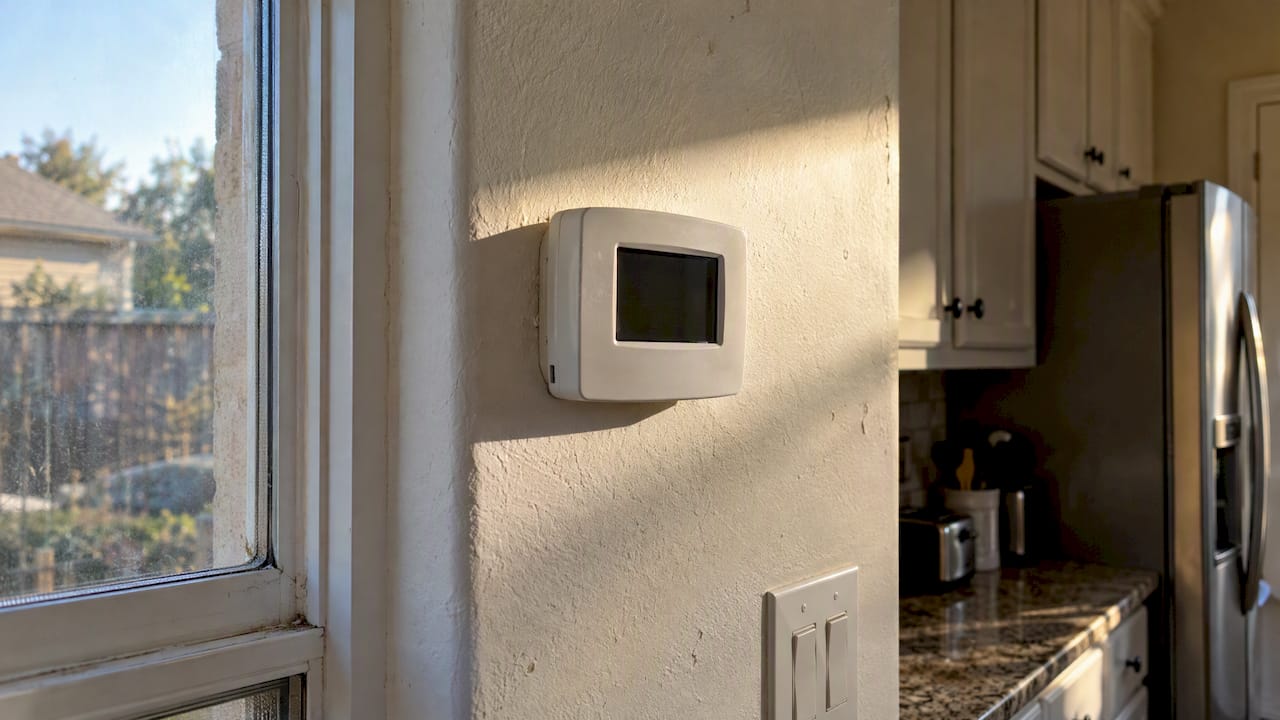
A thermostat that reads the wrong temperature will run the furnace for the wrong length of time. According to Wyze’s troubleshooting article, wiring problems can keep the heat from shutting off, and a spot near a drafty window, an exterior door or a heat-generating appliance can make the thermostat misread the room. Check for a lamp, a sunny window or a kitchen wall behind it.
In Fort Bend County homes, a common version is a thermostat on a wall shared with a sun-baked west-facing room or near the kitchen. If yours is in a spot like that, the furnace may be reacting to a local hot spot while the rest of the house keeps heating.
Replace dead batteries, check for a schedule
A thermostat with weak batteries can act strangely, and a hold or schedule override may be pushing the setpoint high. Cancel any hold, restore the schedule, and watch for a full cycle. Our furnace won’t turn on guide covers the opposite problem, and many of the same thermostat checks apply.
The Test That Tells You If the Furnace Itself Is at Fault
If the lowest-setpoint test fails, the key question is whether the thermostat is the one telling the furnace to run.
Repair Clinic says that if the furnace still won’t turn off after power to the thermostat is cut or the thermostat is removed from the wall, the cause is likely inside the furnace’s own electrical components, and a technician needs to diagnose and repair it. For most homeowners, the right move here is to stop testing. Turn the thermostat to Off, and if the furnace is still running, switch the furnace’s dedicated power switch off and call us.
Don’t keep cycling the breaker as a workaround. A system that only stops when you cut its power is telling you a safety or control part has failed.
Common Reasons a Furnace Won’t Shut Off
| Cause | What you notice | Who fixes it |
|---|---|---|
| Fan set to On or circulate mode | Air moves continuously, but it isn’t hot | You, at the thermostat |
| Thermostat misreading the room | Long cycles, uneven rooms | You (relocation tips) or a technician |
| Thermostat wiring fault | Heat won’t stop even at the lowest setpoint | Technician |
| Stuck relay on the control board | Furnace runs even with the thermostat off or removed | Technician |
| Failed limit switch | Blower runs constantly | Technician |
| Damaged contactor | Equipment stays energized | Technician |
| Leaky ducts or dirty filter | Long run times, dust, high bills | Technician for ducts, you for the filter |
The mechanical items in the middle of that table come straight from the source we cited above. Repair Clinic lists a faulty limit switch, a stuck relay on the control board and a damaged thermostat contactor as the failures that keep a heater on.
The limit switch and the blower
The limit switch watches the temperature inside the furnace and tells the blower when to start and stop. When it fails or drifts, the blower may never get the signal to shut down. You can hear it: air keeps moving through the vents long after the burners stop.
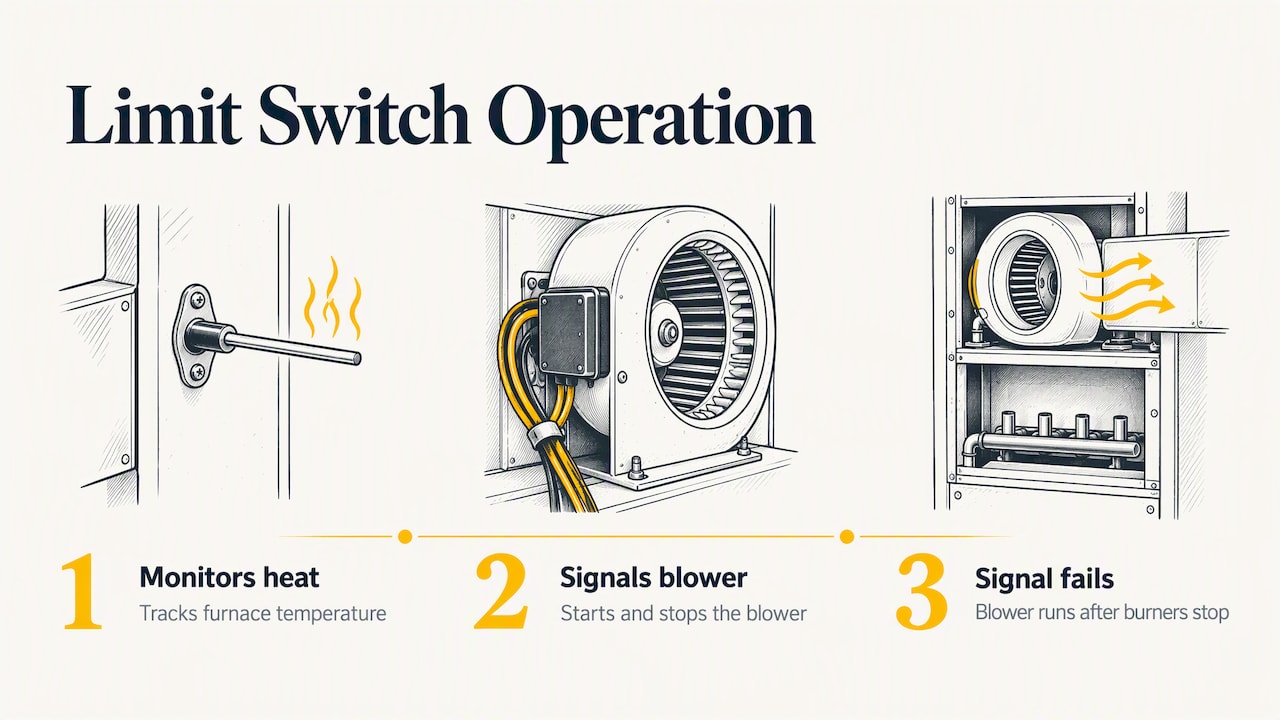
A blower that runs nonstop isn’t an emergency by itself, but it wears the motor and raises your electric bill. Left alone, it can turn a modest repair into a motor replacement. Our published range for blower motor replacement is $400-$900, versus $150-$600 for a typical furnace repair. That gap is a good reason not to wait.
A stuck relay
The relay on the control board is the electrical switch that tells the furnace to run. When its contacts stick closed, the board keeps calling for heat no matter what the thermostat says. This is where the “even with the thermostat removed” symptom comes from. Replacing a relay or a board is a job for a trained technician working with live low-voltage and line-voltage circuits.
Dirty filters and restricted airflow
A clogged filter, blocked vents or a dirty blower wheel restrict airflow and can make the system run longer or shut itself off on its high-limit protection. Check and replace the filter, and make sure supply vents and returns aren’t covered by furniture or rugs. This helps with the “runs constantly” version of the problem, but it won’t fix a relay stuck closed.
When It Runs Nonstop but the House Won’t Warm Up
If your furnace runs for hours and the house still lags behind the thermostat, the issue is probably not a switch that won’t open. The system is working as designed, just not keeping up. Common culprits:
- Leaky or disconnected ducts. The U.S. Department of Energy’s HVAC guide for contractors and homeowners notes that leaky ducts can pull air from unconditioned spaces and even backdraft combustion gases. A persistently dusty house or a sudden jump in utility bills can be a clue.
- Undersized or aging equipment. A furnace that can’t meet demand on the coldest nights runs without stopping.
- Poor air return. Returns that are too small starve the system of air.
These are things a technician measures, not guesses. If you suspect any of them, a diagnostic visit is the sensible first step. We explain what happens in one in our furnace diagnosis walkthrough.
Safety: When to Shut It Down and Leave
A heater that keeps running can overheat. A heater that is malfunctioning can also produce carbon monoxide. Treat these signs as stop signs rather than troubleshooting steps:
- A carbon monoxide alarm sounds.
- You smell burning, hot metal or an electrical odor.
- Anyone in the home has headaches, dizziness or nausea that eases when they go outside.
- The cabinet is hot to the touch or you see scorching.
The EPA’s carbon monoxide guidance says to turn off potential CO sources, including the furnace, ventilate the home, and have a qualified professional inspect the system before using it again. The same page warns that carbon monoxide is colorless and odorless and, at high levels, can kill in minutes. If anyone feels ill, leave the house and call 911.
While you’re thinking about household safety, it’s also worth having a written escape plan. This family fire preparedness plan is a practical place to start for planning what everyone does and where you meet.
If a technician has told you a system is unsafe in the past, our write-up on signs your heating system is unsafe explains what we look for.
What the Repair Usually Costs
Here are the published Temper Mechanical ranges for the work that most often fixes a heater that won’t shut off. Final cost depends on the part and what the diagnosis finds.
| Service | Published range |
|---|---|
| Diagnostic visit | $75-$150 |
| Furnace repair | $150-$600 |
| Thermostat replacement | $150-$400 |
| Blower motor replacement | $400-$900 |
| Furnace replacement | $2,500-$5,500 |
For the details behind these figures, see our furnace repair cost guide. If a thermostat swap is all you need, you will land on the low end. If the control board or blower motor has failed, expect the higher ranges.
Repair or replace?
A stuck relay or a limit switch on a furnace that is otherwise healthy is almost always worth repairing. Things change when the furnace is old, has needed repeated repairs, or a major component such as the heat exchanger is involved. Our repair vs replace decision guide lays out how we think about it. For a neutral look at how replacement bids should be built, this HVAC replacement cost breakdown explains why a proper load calculation matters before you accept a quote.
Our Perspective: Why Running Nonstop Is Rarely “Just a Thermostat”
We get this call most often on the first cold snap of the season, when a furnace that sat idle for months is asked to work hard. Our experience is that homeowners tend to guess the thermostat, replace it, and find the problem still there. That’s why we start with a fast diagnosis instead of swapping parts.
We take the same approach with every home: tell you what we found, show you the price range before we start, and treat the house like our own. Our technicians are NATE-certified and licensed, and we are a locally owned, minority-certified business serving Richmond and nearby areas. When a repair isn’t the right answer, we’ll say so, and we’ll go through financing options if replacement is the better value.
The cheapest fix is the one you catch early. A blower that runs a little too long is a $150 problem. A motor that burned out from running for weeks is not. And a tune-up before the season, which we cover in signs you need an HVAC tune-up, is how you find a drifting limit switch or a dirty flame sensor before they become a 2 a.m. call.
— Wally
Get It Diagnosed Before Small Becomes Expensive
If your heater still won’t turn off after the thermostat checks above, book a visit with us. We offer 24/7 emergency repair, same-day response and transparent pricing, and a diagnostic visit is published at $75-$150. See our heating and AC repair services, or ask about our HVAC maintenance plans so the next cold front doesn’t catch your system off guard.
How to Prevent It Next Winter
- Schedule a heating tune-up in early fall. Our Fort Bend County heater checklist lists what to do before the first cold front.
- Change the filter on schedule and keep returns clear.
- Leave the fan on Auto unless you’ve chosen circulation on purpose.
- Keep the thermostat away from heat sources and drafts, and have it checked at tune-up if rooms feel uneven.
- Don’t ignore new noises. Banging, squealing or whistling often show up before a control or motor failure. Our heater noise guide explains what each sound can mean.
- Have ducts looked at if the house is dusty or bills climb for no reason.
If your home has a heat pump rather than a gas furnace, the checks differ a bit, and our heat pump repair guide covers them.
FAQ
Why does my furnace keep running after the house reaches the set temperature?
The most common causes are a fan set to On, a thermostat that misreads the room, or a control part such as a relay stuck closed. Set the fan to Auto and lower the temperature to its minimum for a few minutes. If the heat still doesn’t stop, call a technician.
Is it safe to leave a furnace running that won’t turn off?
Not for long. Turn the thermostat off, and if the furnace still runs, switch off its power and call for service. If a carbon monoxide alarm sounds, or you smell burning, leave the house and call 911.
Why does my furnace run constantly but the house stays cold?
That usually points to airflow or capacity: a clogged filter, leaky ducts, blocked vents or equipment that can’t keep up. A technician can measure airflow and temperature rise to find which one it is.
Can a bad thermostat make a heater run nonstop?
Yes. Wiring faults, a poor location or a failing unit can keep a call for heat active. If the furnace still runs with the thermostat removed from the wall, though, the thermostat isn’t the cause.
How much does it cost to fix a furnace that won’t shut off?
Our published ranges are $75-$150 for a diagnostic visit and $150-$600 for furnace repair. A thermostat replacement runs $150-$400, and a blower motor replacement runs $400-$900. The diagnosis tells you which one applies.
Sources
- Repair Clinic: Furnace Blower Is Running Constantly
- Sensi: Why is my cooling/heating running constantly?
- InspectApedia: Heat Won’t Turn OFF Diagnosis
- Wyze: My Wyze Thermostat is not turning off the heat
- U.S. Department of Energy: Building America HVAC guide
- U.S. EPA: Protect Your Family and Yourself from Carbon Monoxide Poisoning