
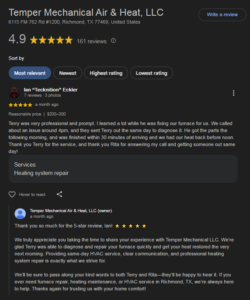
Ian called us at 4 PM on a weekday. His furnace wasn’t working, temperatures were dropping, and he had no idea if anyone would even pick up that late in the afternoon, let alone come out the same day.
We sent Terry out within hours.
By the next morning, Ian had heat again.
That experience stuck with us because it represents exactly what homeowners in Richmond deserve when something goes wrong with their heating system. Not a “we’ll get you on the schedule next week” response. Not a voicemail. Actual same-day service that solves real problems for real families.
But here’s what most homeowners don’t know: same-day furnace repair isn’t magic. There’s a real process behind it. Understanding how it works helps you know what to expect, how to communicate your problem effectively, and why some companies can pull it off while others can’t.
What Actually Happens When You Call at 4 PM
The moment you call matters more than most people realize. A 4 PM call sits in an interesting window. Late enough that some companies start redirecting calls to answering services. Early enough that a properly staffed local HVAC company can still dispatch a technician before the evening ends.
When Ian called, the first thing our team did was ask the right questions. Not just “what’s wrong with your furnace?” but specific questions that help a technician arrive prepared rather than starting from scratch.
Questions that matter during that first call:
What is the furnace doing exactly? Does it try to start and shut off? Is there no response at all? Does it make noise but produce no heat? Each symptom points in a different direction, and knowing beforehand determines what a technician brings in the truck.
How old is the system? A 15-year-old furnace with the same symptoms as a 3-year-old system might have completely different root causes. Age narrows the diagnostic path significantly.
What brand and model do you have? Experienced technicians often know common failure points for specific brands before they ever step through your door. This information shortens diagnostic time considerably.
Has this happened before? Recurring problems signal different causes than first-time failures.
These questions aren’t just intake formalities. They shape whether a technician arrives with the parts most likely needed or has to make an additional supply run, which directly affects how quickly your heat gets restored.
The Drive Over: Why Local Companies Matter for Same-Day Service
When Terry drove to Ian’s home that evening, he wasn’t commuting from a distant dispatch center. He was local. That matters enormously for same-day service in Richmond TX.
National HVAC chains often operate from centralized dispatch, routing technicians from wherever they happen to be in a region. Local companies know Fort Bend County’s neighborhoods. They know the routes, the traffic patterns, and realistically how long it takes to get from one part of Richmond to another.
Local also means inventory. Terry’s service vehicle carried parts appropriate for the systems common in Richmond-area homes. Not a generic national inventory, but parts relevant to the equipment our local community actually uses.
When a technician arrives within hours of your 4 PM call, that response reflects advance preparation, not luck.
What Terry Actually Did When He Arrived
This is where Ian’s experience gets interesting. He specifically mentioned learning a lot while Terry worked. That’s not a small thing. It speaks to how genuine diagnosis differs from rushed guesswork.
Terry didn’t walk in, glance at the furnace, and start replacing parts randomly hoping something worked. He followed a methodical diagnostic process that confirmed the actual problem before touching anything.
Here’s what proper furnace diagnosis includes:
Checking the thermostat first. Many furnace “failures” are actually thermostat failures. Verifying the thermostat communicates correctly with the furnace eliminates the simplest explanation before assuming complex ones.
Inspecting electrical components. Capacitors, contactors, and control boards fail more often than most homeowners realize. Visual inspection combined with electrical testing identifies component failures quickly.
Checking the flame sensor and igniter. These components are responsible for initiating and maintaining combustion. A dirty or failed flame sensor causes furnaces to attempt ignition, fail, and shut down repeatedly. Customers describe this as furnace “clicking” without producing heat.
Examining the heat exchanger. This step matters for safety beyond just function. Cracked heat exchangers allow combustion gases including carbon monoxide to mix with circulating air. Any technician who skips this check isn’t doing a complete job.
Verifying the pressure switches and draft inducer. High-efficiency furnaces use pressure switches confirming proper venting before allowing ignition. A failed inducer motor or blocked flue causes pressure switch failures that prevent furnace operation.
Checking gas pressure and burner operation. Gas supply issues, dirty burners, or ignition problems all present similarly but require different solutions. Proper diagnosis identifies which is actually responsible.
Terry explained each step to Ian as he worked. That patience and transparency is what earns five-star reviews and repeat customers. Understanding what failed and why helps homeowners make informed decisions about repair, maintenance, and future service.
The Part Situation: Why Some Repairs Take Until Morning
Here’s the honest reality of same-day furnace repair that most companies won’t tell you: some repairs genuinely can’t be completed the same day, and that’s not a failure. It’s honesty.
When Terry diagnosed Ian’s furnace that evening, he identified the problem and had a clear repair plan. But the specific part needed wasn’t on his truck. This happens.
The right move, which is what Terry did, is confirming the diagnosis completely, explaining exactly what’s needed, and arranging part procurement for first thing the following morning.
Ian woke up knowing exactly when Terry was returning, what part was coming, and what the repair would cost. That certainty is almost as valuable as having heat restored the same night.
By the following morning, Terry had the part, completed the repair, and Ian’s furnace ran properly before noon.
Compare this to the alternative: Some companies attempt same-day repairs with the wrong parts or incomplete diagnoses, creating temporary fixes that fail within days. That costs homeowners more money and more frustration than a properly communicated overnight wait.
What Homeowners Can Do to Help the Process
Your actions between calling and the technician’s arrival affect how quickly your heat gets restored.
Clear access before they arrive. Furnaces in attics, closets, and utility rooms often have storage stacked against them. Moving boxes, seasonal items, and clutter before the technician arrives saves time and allows immediate work rather than cleanup.
Write down what you’ve noticed. When did the furnace last work properly? What sounds or behaviors preceded the failure? When did the thermostat last get changed? Details you might think are unimportant often provide diagnostic clues that save significant time.
Know your system. If you have your furnace’s model and serial number ready, technicians can often check parts availability before arriving. Stickers on the furnace cabinet contain this information. Take a photo with your phone.
Don’t keep attempting restarts. Repeated manual override attempts when a furnace fails can mask diagnostic clues or cause additional component stress. Once you’ve verified the basics (thermostat settings, circuit breakers, filter condition), let the system rest until the technician arrives.
Make sure someone who knows the home is present. Technicians need access and sometimes need to ask questions about recent changes, noises you’ve heard, or rooms that weren’t heating properly before complete failure. The homeowner is the best information source available.
After the Repair: What Ian Experienced and What You Should Expect
Once a furnace repair is complete, good technicians don’t just pack up and leave. They run the system through complete heating cycles, verify temperatures at vents, confirm safety controls operate correctly, and check that the system starts and shuts down properly.
This post-repair testing catches secondary issues that might not have been obvious before the primary repair. It’s the difference between a technician who’s confident in the work and one who’s hoping it works.
Terry’s repair held. Ian had reliable heat and enough understanding of his furnace to recognize future warning signs before they become emergencies.
That educational component is one of the most valuable things a service call can provide. A homeowner who understands their system makes better maintenance decisions, responds appropriately to warning signs, and isn’t starting from zero when something eventually needs attention again.
Why Same-Day Service Doesn’t Mean Rushed Service
The assumption many homeowners make about same-day furnace repair is that speed means shortcuts. That a technician racing to fit in an evening call must be cutting corners to get there.
Ian’s experience proves otherwise. Same-day service and thorough professional work aren’t mutually exclusive. They coexist when a company is properly staffed, appropriately equipped, and genuinely committed to solving problems rather than just generating service calls.
The technicians who handle same-day furnace repair well aren’t rushing. They’re efficient. Those two things feel similar from the outside but produce very different results inside your heating system.
When Your Furnace Needs Attention Today
If you’re reading this because your furnace is struggling right now, here’s the short version of everything above: call early, describe symptoms specifically, clear access to your equipment, and choose a local company with technicians who explain their work.
Same-day furnace repair in Richmond TX is genuinely possible. Ian’s experience wasn’t exceptional. It’s what professional HVAC service should look like every time.
If your furnace isn’t heating properly, making sounds it shouldn’t, or has stopped working entirely, call Temper Mechanical at (346) 485-8142. Our technicians diagnose problems thoroughly, communicate honestly about timelines and costs, and restore your heat as quickly as the right repair allows.
We serve Richmond, Sugar Land, Rosenberg, Pecan Grove, Katy, and throughout Fort Bend County with heating repair that treats your home and your time with genuine respect.