
If your air conditioner is running but the air from the vents feels warm, start with four free checks: the thermostat, the air filter, the breaker and the outdoor unit. Those fix a fair share of cases in a few minutes. If the air is still warm after that, stop running the system and call a licensed technician. A weak airflow problem, a frozen coil or a refrigerant leak gets more expensive the longer the compressor keeps running.
We are Temper Mechanical, an HVAC company serving Richmond, TX. Below is the order we would check things in, what each cause usually costs to fix, and where a DIY attempt should end.
TL;DR
- Check the thermostat (Cool mode, fan on Auto, setpoint below room temperature), the filter, the breaker and the outdoor unit before you call anyone.
- A dirty filter, a dirty coil, a failed capacitor, a blocked drain and low refrigerant are the usual culprits. Low refrigerant means a leak, so topping off is not a real fix.
- If the indoor lines are icing up, the outdoor fan is dead or you smell burning, switch the system off and call.
- In Richmond, published repair ranges on our site run from $75 to $150 for a diagnostic visit up to $250 to $1,500 for a refrigerant leak repair and recharge.
- A yearly spring tune-up catches most of these problems before the first 95° afternoon.
Table of Contents
- Five-minute checks before you call
- Why an AC blows warm air: the usual causes
- What each fix typically costs in Richmond
- What a proper diagnosis looks like
- Is it an emergency?
- Our perspective: the cheap fix and the real fix
- Keep it from happening again
- Book a diagnosis in Richmond
- FAQ
- Sources
Five-minute checks before you call
Do these in order. None needs tools, and none puts you near a live electrical part.
- Thermostat. Confirm it is set to Cool and the setpoint is below the current room temperature. Make sure the fan is on Auto, not On. HVAC.com’s troubleshooting guide lists these first, and a fan set to On can push room-temperature air through the vents between cooling cycles. That feels exactly like a warm-air problem. Dead thermostat batteries can also cause odd behavior.
- Air filter. Pull it out and hold it to the light. If you cannot see through it, replace it. ENERGY STAR recommends inspecting a central-system filter monthly and changing or cleaning it when dirty. HVAC.com says filters commonly need replacing every one to three months, depending on use. In a Texas summer with the system running most of the day, plan on the short end of that range.
- Breakers and the disconnect. The outdoor condenser and the indoor air handler are often on separate breakers. If one tripped, the blower can run while the compressor sits idle, so air moves but never cools. Reset a tripped breaker once. If it trips again, leave it off and call.
- Outdoor unit. Look at it from a safe distance. Is the fan spinning? Is it humming but not starting? Is it buried in grass clippings, a fence panel or a pile of leaves? Clear debris from around it and keep vegetation back so air can get in and out.
- Vents and returns. Make sure supply registers are open and no furniture is blocking the return grille. Closed or blocked vents cut airflow, which cuts cooling.
If you did all five and the air is still warm after 15 to 20 minutes, that is your cue to stop guessing.
Why an AC blows warm air: the usual causes
A warm-air complaint is not automatically a refrigerant problem. The Department of Energy’s air-conditioner diagnostics guideline explains that cooling depends on adequate airflow across the indoor coil, and that airflow, coil condition and refrigerant charge affect each other. Several faults at once can produce misleading symptoms. Here are the causes we see most often, from cheapest to costliest.
Dirty filter or restricted airflow
A clogged filter starves the indoor coil of air. The Department of Energy notes that routinely replacing or cleaning filters can lower air-conditioner energy use by 5 to 15 percent, and a restricted system works harder and cools less. Airflow trouble is not only the filter. The same DOE guideline lists the blower, the coil, duct design, blocked grilles and crushed or kinked flex duct as other restrictions.
A frozen evaporator coil
When airflow drops far enough, the indoor coil can ice over. The DOE guideline gives typical design airflow as 350 to 400 cfm per ton and warns that below 200 cfm per ton can lead to coil icing and greatly shorten compressor life. The sign you can see: ice on the copper line at the outdoor unit or on the indoor coil, and air that gets weaker and warmer over a few hours.
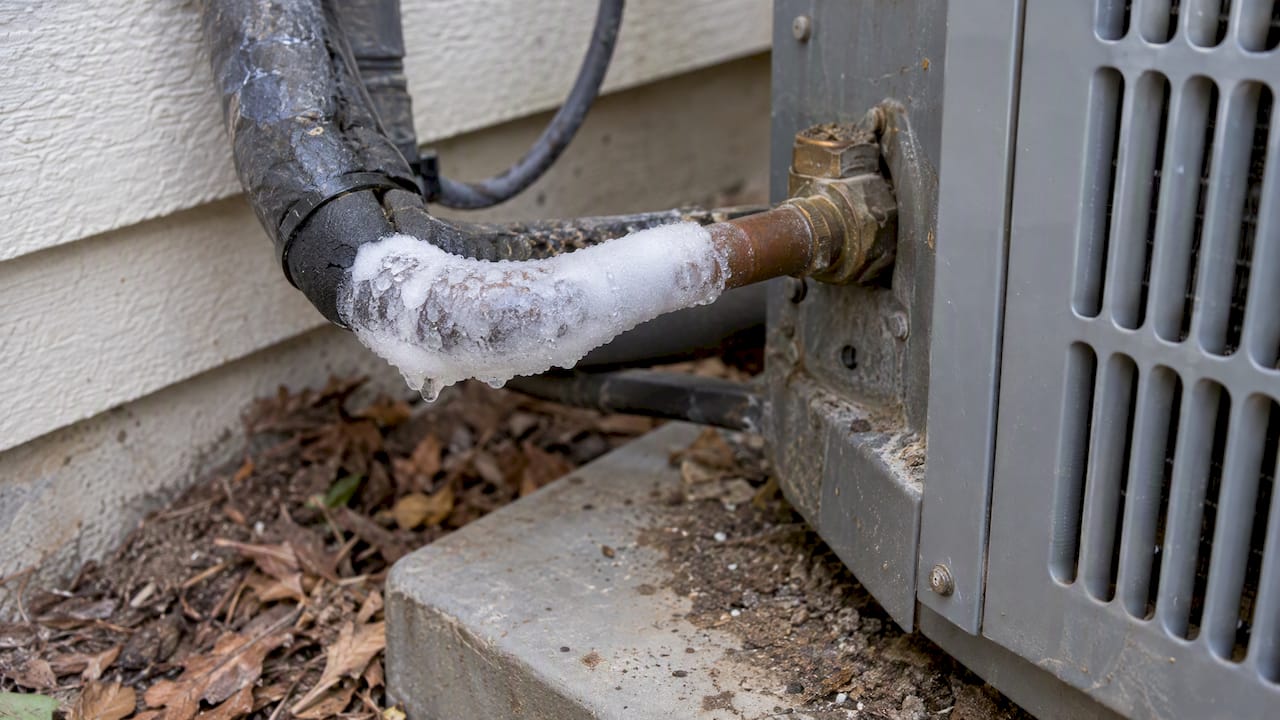
If you see ice, turn the AC off at the thermostat, set the fan to On so air moves over the coil, and let it thaw. Running a frozen system is how a $20 filter turns into a compressor replacement.
Dirty condenser or evaporator coil
The outdoor coil rejects the heat your house collected. Coated in cottonwood fluff, dirt or lawn debris, it cannot do that, and the air inside turns lukewarm. ENERGY STAR lists dirty evaporator or condenser coils among the causes of persistent warm air. A rinse with a garden hose from the outside in, with power off, helps with light surface dirt. Deep cleaning, especially of the indoor coil, is a technician job.
Failed capacitor or electrical fault
A capacitor gives the compressor and the outdoor fan the jolt they need to start. When it weakens, you hear a hum or click at the outdoor unit, the fan does not spin, and the indoor blower keeps blowing air that is not being cooled. Capacitors hold a charge even when the power is off. This is not a homeowner repair. Contactors, wiring and control boards sit in the same category.
Blocked condensate drain
Your AC pulls moisture out of the air, and that water has to leave through the drain line. In humid Richmond summers, algae can clog it. Many systems have a safety switch that shuts the compressor off when the pan fills, so the fan runs and the air is warm. ENERGY STAR includes drain inspection in a standard service visit because a plugged drain can cause water damage and change indoor humidity. If you find standing water around the air handler, call before it reaches your ceiling.
Failed blower motor
If the outdoor unit runs but little or no air comes from the vents, the blower may be failing. The air that does come out can feel warm because the coil is not getting enough air to work against.
Low refrigerant (which means a leak)
Refrigerant does not get used up. If the charge is low, it leaked out somewhere. The Department of Energy’s cooling guidance says to call a trained technician to repair the leak and recharge the system. Symptoms include ice on the lines, a hissing sound, and cooling that fades week over week.
Two things matter here. First, this is not a do-it-yourself job. EPA Section 608 rules govern how technicians service stationary air-conditioning equipment, and EPA prohibits intentional venting of ozone-depleting refrigerants and their substitutes during service. Second, a top-off without finding the leak is a repeat visit waiting to happen. Ask the technician where the leak is, how it will be repaired and how the system will be verified afterward.
Failing compressor
The compressor is the heart of the system. If it has failed, the fans run and the air is warm. It is also the most expensive single component, which is why catching airflow and electrical problems early pays off.
What each fix typically costs in Richmond
These are the ranges published on our site, so you can see where a repair lands before anyone arrives. Your actual quote depends on the equipment, access and what the diagnosis finds.
| Problem | Published range |
|---|---|
| Diagnostic visit | $75-$150 |
| Condensate drain clearing | $75-$200 |
| Capacitor replacement | $150-$400 |
| Evaporator coil cleaning | $150-$400 |
| Thermostat replacement | $150-$400 |
| Blower motor replacement | $400-$900 |
| Refrigerant leak repair + recharge | $250-$1,500 |
| Compressor replacement | $800-$2,800 |
| Full AC system replacement | $3,500-$8,000 |
General AC repair on our site runs $150 to $650. For a deeper look at local pricing, see our Richmond AC repair price guide. Most of the work above is listed on our AC repair page.
The pattern is clear: the cheap causes (filter, drain, capacitor, coil cleaning) are also the ones that go wrong quietly and, left alone, trigger the expensive ones.
What a proper diagnosis looks like
A technician who walks in and says “you need freon” within two minutes has skipped the work. Because airflow, coil cleanliness, electrical condition, the drain, controls and charge all interact, a sound diagnosis checks them as a set. ENERGY STAR’s checklist describes exactly that: thermostat settings, electrical connections, coils, blower airflow, refrigerant charge, controls and condensate drainage.
What you should get from any contractor:
- The failed part named, with the test that shows it failed. “The capacitor reads well below its rating” is a diagnosis. “It’s probably the capacitor” is a guess.
- Airflow checked before refrigerant is added. Adding refrigerant to a system with an airflow problem can hide the real fault.
- A written price before work starts. No surprises on the invoice.
- A repair-versus-replace opinion that explains the math. Age, refrigerant type, the size of the repair and the condition of the rest of the system all count. Our repair vs replace guide lays out how we think about it.
In Texas, air-conditioning contractors are licensed through the state’s Department of Licensing and Regulation, and you can ask any contractor for their license number and verify it. Ours are licensed and NATE-certified technicians.
Is it an emergency?
It depends on who is in the house and what the system is doing.
Call the same day if:
- Anyone is elderly, very young, pregnant or medically fragile and the house is heating up.
- The indoor temperature is climbing toward the 90s.
- You see ice, hear grinding or squealing, or smell something burning. Shut the system off first.
- Water is leaking from the air handler.
It can usually wait a day or two if the house is still livable, the filter was clearly the problem and cooling returned after replacing it, or you have a mild, steady decline in performance and no other symptoms. Even then, do not keep running a system that is blowing warm air for days. If the air is warm, nothing is gained and the equipment is stressed.
We cover what to do when the system fails in peak heat in our emergency AC repair guide for Richmond. For a wider list of reasons a system underperforms, see our Richmond guide to why an AC is not cooling, and if you have a heat pump, read about heat pumps that will not cool or heat.
Our perspective: the cheap fix and the real fix
Most of the warm-air calls we hear about fall into two groups. One is a small thing that was ignored for months: a filter, a drain, a dirty coil. The other is a part that wore out while the system worked too hard to compensate. The second group often started as the first.
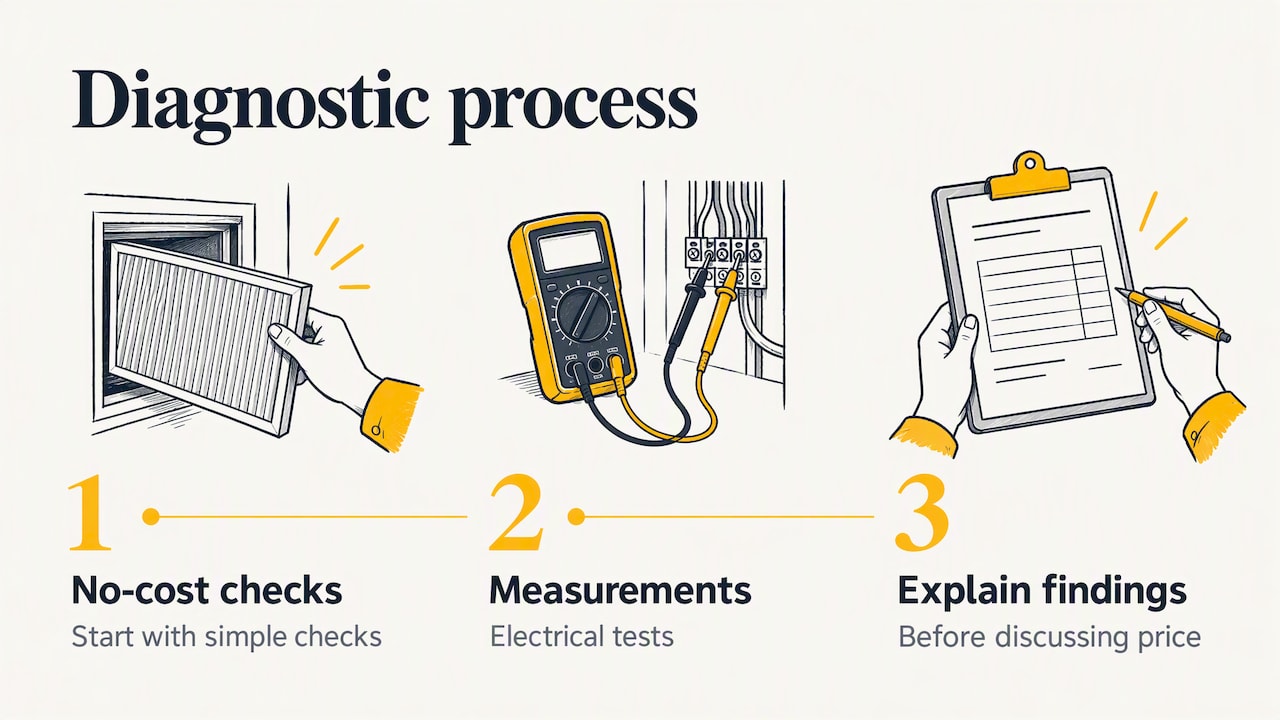
We run diagnoses the way we would want someone to run ours at home. We start with the simple, no-cost checks, move to measurements and electrical tests, and tell you what failed and why before we talk about price. If the answer is a $75 to $200 drain clearing, we would rather tell you that than sell you something bigger. If the answer is a system that is past saving, we will show you the evidence and let you decide, because replacing a working system is as bad as nursing a dead one.
We are locally owned and minority-certified, and we treat every home like it is our own. In a market where much of the AC work is handled by larger outfits with call centers, that means you talk to people who know the neighborhood and the way Richmond’s humidity punishes equipment. If a homeowner, a small business or a property manager tells us the unit runs but the room stays hot, we look at the ducts and returns as well as the condenser, because airflow problems can fool everyone, and replacing serviceable equipment is a costly mistake.
— Wally
Keep it from happening again
Most of the prevention is boring and cheap.
- Check the filter monthly in cooling season and replace it when dirty.
- Schedule a tune-up each spring. ENERGY STAR recommends scheduling cooling maintenance in spring, before contractors get busy in summer, and heating maintenance in fall.
- Keep two feet of clearance around the outdoor unit and rinse off debris.
- Know your drain. If you can reach the condensate line safely, ask your technician to show you where it ends and how to spot a clog.
- Keep the air handler and coils clean. A guide to air handler cleaning explains why that preventive work lowers the odds of summer breakdowns. It is written for Arizona homeowners, but the logic applies in Texas.
Not sure whether your system is due? Our list of signs you need an HVAC tune-up is a good place to check.
Book a diagnosis in Richmond
If the quick checks did not bring the cold air back, we can send a NATE-certified technician for a diagnostic visit (published range $75 to $150) and give you transparent pricing before any repair starts. We offer 24/7 emergency repair and flexible financing for larger jobs. See our AC repair services in Richmond, TX or our HVAC services page, or look at our maintenance plans so next summer’s first hot day is not the day you find out.
FAQ
How do I fix my AC blowing warm air?
Start with the thermostat (Cool, fan Auto, setpoint below room temperature), then replace a dirty filter, check the breaker and clear debris from the outdoor unit. If the air is still warm, the cause is probably a failed capacitor, a dirty or frozen coil, a clogged drain or a refrigerant leak. Those need a technician with the right tools and certification.
Should I turn off the AC if it is blowing warm air?
Yes, if it stays warm after the basic checks or you see ice, smell burning or hear grinding. Running a struggling system can damage the compressor. If you see ice, switch to fan only until it thaws and then call for service.
Is an AC blowing hot air an emergency?
It is when the house is heating up and someone vulnerable lives there, or when you see water leaking, ice or signs of electrical trouble. In a Texas summer, do not wait long. If the house is still comfortable and a new filter solved it, you can schedule a regular visit.
How do I reset an AC that is not blowing cold air?
Turn the thermostat to Off, switch the breaker off for a minute or two, then turn it back on and set the thermostat to Cool. Try this once. If the breaker trips again or the unit still does not cool, leave it off and call a technician, because repeated resets can damage components.
Sources
- AC Troubleshooting: Common Problems and How to Fix Them, HVAC.com
- Maintenance Checklist, ENERGY STAR
- How to Keep Your HVAC System Working Efficiently, ENERGY STAR
- Tips for Lowering Your Cooling Costs, U.S. Department of Energy
- Measure Guideline: Air Conditioner Diagnostics, Maintenance, and Replacement, U.S. Department of Energy
- Stationary Refrigeration Service Practice Requirements, U.S. EPA
- Stationary Refrigeration: Prohibition on Venting Refrigerants, U.S. EPA