
If you have lived in The Grove or Pecan Grove for any length of time, you already know that this part of Richmond TX is a genuinely wonderful place to put down roots. Beautiful neighborhoods, mature trees, well-kept homes, and a real sense of community. What most homeowners here do not know, at least not until something goes wrong, is that the ground beneath those homes has been quietly working against their plumbing since the day the foundation was poured.
This is not a scare story. It is a straightforward explanation of something that affects thousands of homes in the 77406 area, and understanding it is the first step toward protecting your property before a small issue becomes a large one.
The Ground Beneath Your Home Is Not Sitting Still
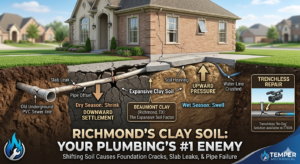
The soil throughout the Richmond TX area, including The Grove and Pecan Grove, is predominantly what geologists and engineers refer to as Beaumont Clay. This is an expansive clay soil, meaning it does not behave the way most people assume soil behaves.
Most of us picture soil as something stable and fixed. It sits there, it holds things up, and it stays put. Beaumont Clay does not work that way. It acts more like a slow-motion sponge. When rainfall is heavy and moisture saturates the ground, this clay absorbs water and swells. When dry summer conditions set in and that moisture evaporates, the clay contracts and pulls back. Back and forth, season after season, year after year.
In a place like Richmond TX where summers are long and dry and storm seasons can drop significant rainfall in short periods, that cycle of swelling and shrinking happens repeatedly throughout the year. The ground beneath your home is in a constant state of gradual movement, and most homeowners never feel it or see it directly.
But your underground pipes do.
What This Movement Does to Your Plumbing
When soil shifts, it does not move in a perfectly uniform way. Different sections of ground absorb and release moisture at different rates depending on drainage patterns, tree root systems, irrigation, and how the grade of your property channels water. This uneven movement creates what engineers call shear stress on anything buried in the ground.
Your underground sewer lines and water supply pipes sit directly in this environment. Whether they are made of PVC or older cast iron, they were installed as straight, connected, sealed systems. When the soil around them shifts in different directions at different rates, that stress accumulates at the joints, the connection points, and any section where the pipe changes direction.
Over time, joints begin to separate. Pipes develop hairline cracks. Sections that were once perfectly aligned begin to offset, meaning one end shifts slightly out of position from the other. None of this happens dramatically or suddenly. It happens slowly, consistently, and silently over years of seasonal soil movement.
By the time most homeowners in the 77406 area notice a symptom, the underlying issue has usually been developing for quite a while.
6 Warning Signs Your Pipes Are Being Affected by Clay Soil
This is where the damage becomes visible — if you know what to look for. Underground pipe problems caused by clay soil movement rarely announce themselves with a dramatic failure. Instead, they show up as a pattern of small, seemingly unrelated issues around your home. In 2026, we are seeing this more frequently in Richmond TX after the wet and dry swings of recent seasons.
Here are the six most specific warning signs we see in homes across The Grove, Pecan Grove, and the broader 77406 community.
1. Drains That Slow Down in Multiple Fixtures at the Same Time
If one drain is slow, it is usually a localized clog. But when two or three drains in different parts of your home start slowing down around the same time — the kitchen sink, a bathroom, the laundry — that points much further down the line. A shifted or partially collapsed pipe restricts flow across the whole system, not just one spot. Most homeowners reach for drain cleaner first. It will not fix an offset pipe.
2. Gurgling Sounds From Toilets or Drains After Use
That gurgling noise after you flush or drain a sink is the sound of air moving through a pipe system that is struggling to vent properly. When clay soil movement causes a pipe to sag or partially collapse, it creates low points where water pools and air gets trapped. The gurgle is the air trying to escape past the obstruction. It is easy to dismiss this as a minor annoyance. It is actually one of the earliest signs the system is telling you something is wrong underground.
3. A Sewage Smell That Comes and Goes With No Obvious Source
A faint sewage odor that appears occasionally and then disappears is one of the most commonly ignored warning signs in Richmond TX homes. Homeowners check the bathrooms, run some water in rarely-used drains, and assume the problem is solved. But when that smell keeps coming back over weeks or months, it often traces to a crack or joint separation in the sewer line beneath the slab. Sewer gas escapes through the break and works its way up through the foundation. No amount of cleaning will fix a cracked pipe underground.
4. Soft, Wet, or Unusually Green Patches in Your Yard
A sewer line leak beneath your yard releases moisture and organic material into the surrounding soil. That soil becomes softer, stays wetter longer after rain, and often produces noticeably greener or more lush grass directly above the leak. This is one of the clearest physical signs visible from outside your home. If you have a patch of yard that stays spongy underfoot or stays noticeably greener than everything around it — and there is no irrigation line running through that area — a leaking underground pipe is one of the first things worth ruling out.
5. Foundation Cracks or Sticking Doors in a Home With No History of Those Issues
Clay soil movement affects your foundation as well as your pipes, but there is a specific version of this that is plumbing-related rather than purely soil-related. When a pipe beneath your slab leaks consistently, the water it releases causes localized swelling in the clay immediately beneath your foundation. That swelling creates uneven upward pressure — called heaving — which pushes sections of your slab slightly out of level. The result is doors that suddenly stick or no longer latch, drywall cracks appearing near door frames and window corners, and tile floors that develop cracks along the grout lines. If these things are happening in a home that had no such issues before, and they appeared gradually rather than after a specific event, underground pipe moisture is worth investigating seriously.
6. A Water Bill That Has Increased With No Change in Usage
This one is straightforward but frequently overlooked. A supply line with a crack or joint separation that is losing water underground will not show a puddle. It will show up on your bill. If your monthly water usage in 2026 has crept up compared to the same months in previous years, and you have not added irrigation, a new appliance, or extra people in the household, that water is going somewhere. A steady but invisible leak beneath the slab in a Richmond TX home can waste thousands of gallons before anyone notices it — and by the time the bill makes the problem obvious, the pipe has usually been leaking for longer than most homeowners realize.
Your Home Is Trying to Tell You Something

Here is where things get interesting. Underground pipe damage does not always announce itself through an obvious plumbing failure. A lot of the early warning signs look like home maintenance issues rather than plumbing problems, which is exactly why they get misread or ignored for longer than they should be.
Pay attention if you notice any of these in your home:
- Interior doors that have started sticking or no longer latch the way they used to
- Hairline cracks appearing in drywall, especially near door frames and window corners
- Floor tiles that sound hollow when you tap them or that have begun to crack along grout lines
- Unexplained wet or soggy patches in your yard that do not dry out normally after rain
- A water bill that has increased without any change in how much water your household uses
- Warm spots or damp areas on your slab floor, particularly noticeable on tile surfaces
- A faint sewage smell that you cannot locate no matter how thoroughly you clean
Each of these on their own might have an innocent explanation. But when two or three of them are happening at the same time, especially in a home that sits on Beaumont Clay in the 77406 area, the connection to underground pipe movement is worth taking seriously.
The sticking doors and drywall cracks deserve a specific explanation because homeowners often attribute these to normal settling. In some cases that is true. But when a pipe beneath your slab is leaking consistently, the moisture it releases into the soil beneath your foundation creates localized swelling that can cause sections of your slab to shift or heave unevenly. That movement is what pushes door frames slightly out of square and creates stress cracks in your walls. The plumbing and the structure of your home are more connected than most people realize.
This Is a 77406 Problem That Needs a Local Solution
It is worth saying directly that this is not a problem you will find equally distributed across every part of the Houston metro area. The specific composition of Beaumont Clay is particularly concentrated in the Fort Bend County region, and neighborhoods like The Grove and Pecan Grove sit squarely in that zone.
General plumbing companies that work across a wide service area may not have deep familiarity with how Richmond’s specific geography affects underground pipe systems. A technician who primarily works in areas with sandier or more stable soil compositions may not immediately connect the plumbing symptoms to the soil movement patterns that are common here.
This is one of the reasons that specialized underground pipe repair performed by a team that understands Richmond TX specifically is so important. The diagnosis, the repair approach, and the materials used all benefit from local knowledge about how these pipes behave in this particular environment over time.
If you are also experiencing slow drains, backups, or visible clog issues alongside these symptoms, our drain cleaning service in Richmond TX can help identify whether the issue is a surface-level blockage or something deeper in the line. And for homeowners dealing with a sudden rupture or active leak, our emergency plumbing team in Richmond TX is available to respond quickly.
The Good News About All of This
Understanding what is happening beneath your home is genuinely empowering. Once you know that Beaumont Clay is a real and manageable factor rather than a mysterious invisible threat, you can respond to the early warning signs with the right action at the right time.
Modern pipe inspection and repair technology means that addressing an underground pipe problem no longer requires excavating your yard or breaking up your landscaping. Video inspection allows a technician to see exactly what is happening inside your pipes without any digging at all. What is found then determines the right repair approach, and in many cases trenchless repair methods can restore full pipe function from the inside out without disturbing your yard, your driveway, or your foundation.
The homeowners who protect their properties most effectively are the ones who do not wait for a dramatic failure before acting. Catching an offset joint or a developing crack early keeps the repair smaller, less invasive, and significantly less expensive than addressing the damage after it has progressed.
For homeowners with older homes or those who have not had an inspection in several years, it is also worth reviewing our full plumbing services in Richmond TX to understand what a comprehensive assessment covers and what to expect from the process.
Take the First Step With a Video Pipe Inspection
If you are reading this and recognizing two or more of the warning signs mentioned above in your own home, the most useful next step is a professional video pipe inspection. This gives you a clear, documented picture of what is actually happening inside your underground pipes so you can make an informed decision about whether and how to address it.
At Temper Mechanical Air & Heat LLC, we serve The Grove, Pecan Grove, and the surrounding 77406 community with honest, thorough plumbing inspections and underground pipe repair solutions designed specifically for Richmond TX homes and the soil conditions they sit on.
Right now in 2026 we are offering $50 OFF any repair service for new customers. Mention this when you call and we will apply it automatically to your visit.
Your home is worth protecting, and knowing what is happening beneath it is the place to start.
Temper Mechanical Air & Heat LLC Richmond TX | Licensed | BBB-Accredited | Minority Business Certified | Flexible Financing Available Proudly Serving The Grove, Pecan Grove, and the 77406 Community