
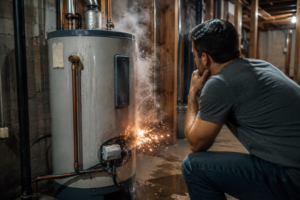
You are standing in your kitchen or walking past the utility closet when you hear it. A sharp popping sound, maybe followed by a few more, coming from inside your water heater. It sounds almost like something is knocking around in there, or worse, like pressure building up somewhere it should not be.
Your mind goes straight to the worst case scenario. Is the tank about to burst? Is this dangerous? Should you be evacuating the house right now?
Take a breath. In the vast majority of cases, this sound is not a sign of impending disaster. It is your water heater telling you something specific, and once you understand what is actually happening inside that tank, the noise stops being scary and starts being something you can actually address.
This guide walks you through exactly what causes that popping sound, why it happens more in this part of Texas than almost anywhere else, and what you should do about it.
What That Popping Sound Actually Is
The short answer is sediment. The slightly longer answer is worth understanding because it explains why the problem happens and why it tends to get worse over time if it goes unaddressed.
Every water heater tank collects mineral deposits over time. As water enters your tank and gets heated, the minerals dissolved in that water, mainly calcium and magnesium, gradually settle at the bottom of the tank. Over months and years, this creates a layer of hardened sediment sitting right above your heating element or burner.
Here is where the noise comes from. Water gets trapped underneath and inside pockets of that sediment layer. When your heating element or gas burner fires up, it heats that trapped water rapidly. Trapped water heating up quickly turns to steam, and that steam has to escape through the hardened sediment layer above it. As it pushes through, it creates small bursts and pops, sometimes rapid and sharp, sometimes more like a rolling rumble.
Think of it like a covered pot of water starting to boil. Before it reaches a full rolling boil, you hear those small popping and cracking sounds as bubbles form and struggle to rise. That is essentially what is happening inside your tank, just contained within a layer of mineral buildup instead of an open pot.
The sound can range from a few subtle pops here and there to a fairly loud and persistent rumbling, almost like gravel shifting inside the tank. The volume and frequency usually correlate directly with how much sediment has accumulated.
Why This Happens More Often in Richmond TX and Fort Bend County
If you have lived in other parts of the country before moving here, you may notice your water heater seems to develop this problem faster than units you have owned elsewhere. There is a real reason for that.
Fort Bend County water is considered hard water, meaning it carries a higher concentration of dissolved minerals, primarily calcium and magnesium, compared to many other regions. Every gallon of water that flows into your tank carries a small amount of these minerals with it. Over time, that adds up significantly faster here than it would in an area with softer water.
What might take five or six years to become noticeable in a low mineral content region can show up within two to three years in a home here in Richmond TX. This is not a reflection of a lower quality water heater or poor installation. It is simply a consequence of the water supply itself.
This is also why sediment buildup is one of the most common calls we receive from homeowners across Richmond, Sugar Land, Rosenberg, and Pecan Grove. It is not an unusual problem. It is an expected one given the local water conditions, and understanding that helps take some of the anxiety out of hearing those sounds for the first time.
Is It Dangerous? Here Is the Honest Answer
Most of the time, no. The popping sound itself is not typically an indication of an unsafe or emergency situation. It is a sign of reduced efficiency and increasing internal wear, not an active safety hazard.
However, there are a few important distinctions worth understanding.
Sediment buildup itself is not dangerous, but it accelerates wear.
The sediment layer acts as an insulating barrier between your heating element or burner and the water it is trying to heat. This forces your system to run longer and work harder to reach the same temperature, which increases energy costs and puts additional stress on components that were not designed to work that hard consistently.
Prolonged sediment buildup can eventually lead to tank damage.
Over years, thick sediment layers can cause localized overheating at the bottom of the tank, which in some cases contributes to premature tank failure or leaks. This is a gradual process, not an immediate one, but it is a real long term consequence of ignoring the problem.
A different noise pattern could indicate something more serious.
If the popping is accompanied by hissing, whistling, or a sound of water spraying, or if you notice water pooling around the base of your unit, that points toward a different issue entirely, potentially involving a pressure relief valve problem or an active leak. Our guide on water heater leaks and what to do right now covers exactly what those situations mean and how urgently you need to respond.
The tank is not going to explode from this sound.
This is the fear most people carry when they hear it for the first time, and it is worth addressing directly. Modern water heaters are equipped with a temperature and pressure relief valve specifically designed to release pressure safely if internal conditions ever became genuinely dangerous. Popping from sediment is not the same mechanism as a pressure buildup emergency, and the two should not be confused.
What Happens If You Ignore It
A lot of homeowners hear the popping, decide it is not urgent since the water still gets hot, and move on with their day. That is understandable, but here is what is actually happening in the background while you wait.
Your energy bill climbs gradually. As the sediment layer thickens, your system needs more time and more energy to heat the same amount of water. This does not happen overnight, but it adds up month after month in a way that is easy to miss until you compare bills from a year or two apart.
Your available hot water decreases. Sediment takes up physical space at the bottom of the tank, which reduces the actual volume of water your tank can hold and heat effectively. A 50 gallon tank with several inches of hardened sediment might only be functioning like a 40 gallon tank in practice.
Your heating element wears out faster on electric units. The lower heating element on an electric water heater sits closest to the sediment layer and takes the most direct impact from the extra strain. This is one of the most common reasons for premature element failure in homes throughout this area.
The noise itself gets louder and more frequent. Sediment does not resolve on its own. It compounds. What started as a few subtle pops becomes a more persistent rumbling sound as more mineral deposits accumulate over time.
What You Can Do About It
Flush your tank.
This is the direct solution to sediment buildup and it is something that can be done either by a homeowner comfortable with basic plumbing tasks or by a professional during a routine service visit. Flushing involves draining water from the bottom of the tank through the drain valve until it runs clear, removing loose sediment before it hardens further.
For tanks with several years of accumulated buildup, a single flush may not remove everything, particularly if the sediment has hardened significantly. In these cases, a professional flush using specialized equipment does a more thorough job than a standard homeowner drain and refill.
Make it an annual habit, not a one time fix.
Given how quickly sediment accumulates in this area, an annual flush is genuinely one of the highest value maintenance tasks you can perform on your water heater. It is inexpensive, it takes very little time, and it directly addresses the root cause of the popping noise along with the efficiency losses and premature wear that come with it.
Consider a water softener if the problem keeps returning quickly.
If you find yourself flushing your tank and hearing the noise return within just a few months, the underlying water hardness in your home may benefit from a broader solution. A whole home water softening or filtration system reduces the mineral content in your water supply before it ever reaches your water heater, which slows sediment accumulation significantly across every appliance in your home, not just the water heater.
Have a technician inspect the anode rod at the same time.
The anode rod is a sacrificial component inside your tank designed to attract corrosive elements before they can damage the tank itself. It works alongside sediment buildup in determining your tank’s overall lifespan. A technician performing a flush can typically check the rod’s condition in the same visit, which is efficient and helps you understand your unit’s overall health rather than addressing symptoms in isolation.
When to Call a Professional Instead of Flushing It Yourself
Flushing a water heater is a manageable task for many homeowners, but there are specific situations where calling a professional makes more sense.
If you have never flushed your tank before and it has been more than three or four years since installation, the sediment may be significantly hardened. In these cases, attempting a standard flush can sometimes clog the drain valve itself, which then requires a technician to resolve anyway.
If your unit is older and you are uncertain about its overall condition, a professional visit gives you the opportunity to have the whole system assessed at once rather than addressing sediment in isolation. Our guide on how to fix a water heater and understand your specific problem walks through the broader diagnostic process if you want a complete picture of your system’s health before deciding on next steps.
If the popping noise is loud, frequent, and has developed suddenly rather than gradually, it is worth having a technician confirm that sediment is genuinely the cause rather than assuming it based on the symptoms alone.
The Bottom Line
That popping sound coming from your water heater is unsettling the first time you hear it, but in nearly every case it is simply sediment buildup rather than a sign of imminent danger. It is common throughout Richmond TX and Fort Bend County specifically because of the hard water conditions in this region, and it is a completely manageable issue once you understand what is happening and address it directly.
Left unaddressed, it gradually increases your energy costs, reduces your available hot water, and shortens the working life of your unit. Addressed with a proper flush, ideally on an annual basis given local water conditions, it stops being a problem entirely.
If you are hearing this noise right now and want a professional to take a look, flush the tank thoroughly, and check the overall condition of your water heater while they are there, we are ready to help.
Call Temper Mechanical at (346) 485-8142
We serve Richmond TX, Sugar Land, Rosenberg, Pecan Grove, and all of Fort Bend County with same day service, upfront pricing, and technicians who explain exactly what they find before doing any work.
Temper Mechanical Air & Heat LLC
6115 FM 762 Rd Suite 1200, Richmond TX 77469
Licensed. Bonded. BBB Accredited. Minority Business Certified. Flexible Financing Available.