
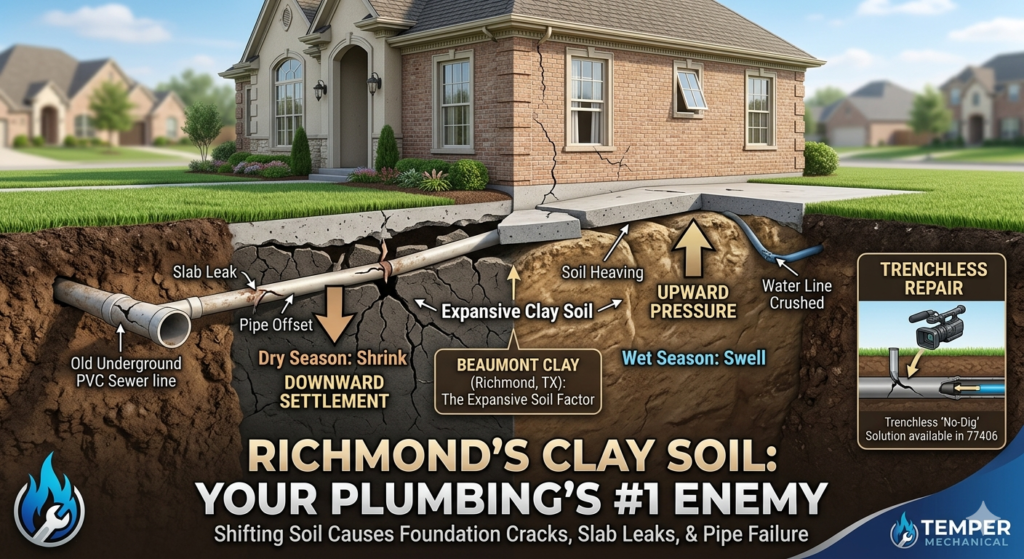
Why Richmond’s Clay Soil is the #1 Enemy of Your Home’s Plumbing
If you have lived in The Grove or Pecan Grove for any length of time, you already know that this part of Richmond TX is a genuinely wonderful place to put down roots. Beautiful neighborhoods, mature trees, well-kept homes, and a real sense of community. What most homeowners here d o not know, at least not until something goes wrong, is that the ground beneath those homes has been quietly working against their plumbing since the day the foundation was poured. This is not a scare story. It is a straightforward explanation of something that affects thousands of homes in the 77406 area, and understanding it is the first step toward protecting your property before a small issue becomes a large one. The Ground Beneath Your Home Is Not Sitting Still The soil throughout the Richmond TX area, including The Grove and Pecan Grove, is predominantly what geologists and engineers refer to as Beaumont Clay. This is an expansive clay soil, meaning it does not behave the way most people assume soil behaves. Most of us picture soil as something stable and fixed. It sits there, it holds things up, and it stays put. Beaumont Clay does not work that way. It acts more like a slow-motion sponge. When rainfall is heavy and moisture saturates the ground, this clay absorbs water and swells. When dry summer conditions set in and that moisture evaporates, the clay contracts and pulls back. Back and forth, season after season, year after year. In a place like Richmond TX where summers are long and dry and storm seasons can drop significant rainfall in short periods, that cycle of swelling and shrinking happens repeatedly throughout the year. The ground beneath your home is in a constant state of gradual movement, and most homeowners never feel it or see it directly. But your underground pipes do. What This Movement Does to Your Plumbing When soil shifts, it does not move in a perfectly uniform way. Different sections of ground absorb and release moisture at different rates depending on drainage patterns, tree root systems, irrigation, and how the grade of your property channels water. This uneven movement creates what engineers call shear stress on anything buried in the ground. Your underground sewer lines and water supply pipes sit directly in this environment. Whether they are made of PVC or older cast iron, they were installed as straight, connected, sealed systems. When the soil around them shifts in different directions at different rates, that stress accumulates at the joints, the connection points, and any section where the pipe changes direction. Over time, joints begin to separate. Pipes develop hairline cracks. Sections that were once perfectly aligned begin to offset, meaning one end shifts slightly out of position from the other. None of this happens dramatically or suddenly. It happens slowly, consistently, and silently over years of seasonal soil movement. By the time most homeowners in the 77406 area notice a symptom, the underlying issue has usually been developing for quite a while. Your Home Is Trying to Tell You Something Here is where things get interesting. Underground pipe damage does not always announce itself through an obvious plumbing failure. A lot of the early warning signs look like home maintenance issues rather than plumbing problems, which is exactly why they get misread or ignored for longer than they should be. Pay attention if you notice any of these in your home: Interior doors that have started sticking or no longer latch the way they used to Hairline cracks appearing in drywall, especially near door frames and window corners Floor tiles that sound hollow when you tap them or that have begun to crack along grout lines Unexplained wet or soggy patches in your yard that do not dry out normally after rain A water bill that has increased without any change in how much water your household uses Warm spots or damp areas on your slab floor, particularly noticeable on tile surfaces A faint sewage smell that you cannot locate no matter how thoroughly you clean Each of these on their own might have an innocent explanation. But when two or three of them are happening at the same time, especially in a home that sits on Beaumont Clay in the 77406 area, the connection to underground pipe movement is worth taking seriously. The sticking doors and drywall cracks deserve a specific explanation because homeowners often attribute these to normal settling. In some cases that is true. But when a pipe beneath your slab is leaking consistently, the moisture it releases into the soil beneath your foundation creates localized swelling that can cause sections of your slab to shift or heave unevenly. That movement is what pushes door frames slightly out of square and creates stress cracks in your walls. The plumbing and the structure of your home are more connected than most people realize. This Is a 77406 Problem That Needs a Local Solution It is worth saying directly that this is not a problem you will find equally distributed across every part of the Houston metro area. The specific composition of Beaumont Clay is particularly concentrated in the Fort Bend County region, and neighborhoods like The Grove and Pecan Grove sit squarely in that zone. General plumbing companies that work across a wide service area may not have deep familiarity with how Richmond’s specific geography affects underground pipe systems. A technician who primarily works in areas with sandier or more stable soil compositions may not immediately connect the plumbing symptoms to the soil movement patterns that are common here. This is one of the reasons that specialized underground pipe repair (visit our service page here) performed by a team that understands Richmond TX specifically is so important. The diagnosis, the repair approach, and the materials used all benefit from local knowledge about how these pipes behave in this particular environment over time. The Good News About All of This Understanding what is happening beneath your home